
Leaking & Failed Tile Shower Repair in Riverwoods, Illinois
A Riverwoods tile shower may show one crack near the drain, movement at a different floor section, & moisture outside the enclosure. Those clues can be related even when they are not next to one another. The shower floor, curb, lower walls, drain, support, & waterproofing operate as a connected assembly, so the visible exit is not always the place where the failure began.
North Shore Tile & Shower Repair starts by mapping the complete pattern. Owner Kristopher Duschen compares where each symptom appears, what activates it, whether anything moves, & what changed after earlier grout, caulk, glass, plumbing, or tile work. That evidence helps define whether a focused repair can end at sound construction or whether the connected portion needs broader reconstruction.
Explore 4NST's tile & shower repair services or send photographs & the symptom pattern for an owner-led inspection.
A Riverwoods tile shower may show one crack near the drain, movement at a different floor section, & moisture outside the enclosure. Those clues can be related even when they are not next to one another. The shower floor, curb, lower walls, drain, support, & waterproofing operate as a connected assembly, so the visible exit is not always the place where the failure began.
North Shore Tile & Shower Repair starts by mapping the complete pattern. Owner Kristopher Duschen compares where each symptom appears, what activates it, whether anything moves, & what changed after earlier grout, caulk, glass, plumbing, or tile work. That evidence helps define whether a focused repair can end at sound construction or whether the connected portion needs broader reconstruction.
Explore 4NST's tile & shower repair services or send photographs & the symptom pattern for an owner-led inspection.
Quick Answer: When Do Separate Shower Symptoms Point to One Connected Failure?
They deserve to be evaluated together when their timing, direction, movement, or response to shower use overlaps. A crack that continues toward a loose area, moisture that appears after the floor has been wet for several minutes, or a leak that changes location after recaulking can indicate that the visible defects share a concealed route. The pattern guides the investigation, but it does not prove one specific failed layer before the assembly is examined.
Build a Four-Part Symptom Map Before Choosing a Repair
A useful shower record separates four observations instead of collapsing everything into “it leaks.”
1. Location
Mark the first visible crack, loose or hollow-sounding tile, darkened joint, curb separation, & every place moisture appears outside the shower. Include the drain, perimeter, lower walls, glass line, bathroom floor, baseboard, adjacent room, & ceiling below when relevant.
2. Timing
Note whether the symptom begins immediately with direct spray, only after several minutes, after the water is turned off, or while the shower is unused. Timing can change which system deserves attention first.
3. Physical response
Record clicking, rocking, deflection, softness, a joint that opens under ordinary pressure, or a tile that sits differently from its neighbors. Movement adds information that a photograph of a dry crack cannot show.
4. Change after earlier work
List what was regrouted, recaulked, sealed, reset, adjusted, or repaired & how the symptom responded. A temporary improvement, no improvement, or a new water exit can narrow the next questions without proving the concealed cause.
The map lets Kristopher compare the symptoms as a system. It also creates a baseline that can be checked against findings if a controlled opening becomes necessary.
Crack Direction Is a Route, Not a Verdict
A crack that follows one grout joint can reflect stress at that joint. A line that crosses several pieces may point toward movement below the finish. A repeated arc around a drain, separation along a curb, or a line continuing from floor to perimeter can redirect attention to support, transitions, or the relationship between connected components.
None of those shapes proves by itself that the substrate, pan, drain, or waterproofing has failed. Tile size, layout, mortar contact, material transitions, & movement accommodation can influence what becomes visible. The useful question is whether the crack aligns with other evidence: loose material, deflection, moisture timing, staining, or the same line returning after repair.
Filling the line can improve appearance. It cannot stiffen a moving base, restore missing bond, correct slope, or reconnect buried water control. When the crack returns, its direction & recurrence should remain part of the diagnostic record.
Movement Changes the Meaning of a Surface Defect
A hollow sound alone does not establish failure, & one loose piece does not prove the entire shower pan is defective. Physical movement matters because it shows that the finish is not responding as a stable surface should.
Compare the moving area with the crack pattern. Does one tile rock while the surrounding field remains firm? Do several pieces move together? Does pressure open a perimeter joint? Does the floor feel different nearer the drain or curb? Does the same area remain dark or release moisture?
An isolated bond defect may support a limited repair if the exposed support & waterproofing remain serviceable. Coordinated movement across several pieces, recurring cracks, softness, or multiple wet boundaries can indicate that a narrow reset would stop before the actual failure ends.
Moisture Timing Can Change Which Trade Comes First
Water visible at a curb, baseboard, bathroom floor, or ceiling is an exit point. It may have traveled along backing, framing, a floor junction, the top of the curb, or another connected path before becoming visible.
If moisture occurs only when spray reaches a door, sweep, track, jamb, or glass return, enclosure containment belongs in the evaluation. If it develops after longer use, accompanies floor movement, or returns despite enclosure work, the tiled assembly may require closer attention. Moisture that appears while the shower is idle can point toward a pressurized supply, fixture, or another plumbing condition that should be addressed by a licensed plumber. A blockage or ordinary drain-clearing problem also belongs with the appropriate drain professional.
4NST specializes in the tiled wet-area assembly: tile, bond, support, slope, waterproofing, curb, perimeter, penetrations, & the tiled system's relationship to the drain. Keeping those trade boundaries clear prevents tile demolition from being used as a guess at an unrelated plumbing defect.
Test Four Boundaries Before Calling a Repair “Selective”
The smallest opening is not automatically the most conservative repair. A responsible focused scope needs four boundaries that agree.
Failure boundary
Movement, moisture effects, weak bond, or a failed transition must end within a definable area. If the condition continues into an adjoining plane, the repair cannot honestly stop at the first visible crack.
Support boundary
The remaining substrate & setting surface must be stable enough to carry the repaired section. New tile cannot correct deflection or deterioration that continues beneath material left in place.
Water-control boundary
New waterproofing needs a reliable connection to a compatible, serviceable portion of the existing system. Surface caulk is not a substitute for continuity inside the assembly.
Access boundary
The failed component must be reachable without sacrificing the connection the repair needs. A curb cap, slab, fixed glass, drain geometry, trim, or unavailable tile can make the practical opening larger than the visible symptom.
When all four boundaries are sound, a focused repair may preserve much of the existing shower. When one boundary remains uncertain or connected failure crosses it, the scope has to expand until the repair can terminate responsibly.
A Controlled Opening Should Test the Pattern
Sometimes the surface record is enough to reject another cosmetic repair but not enough to set the final construction boundary. A controlled opening should answer a defined question: whether movement is local, whether support remains sound beyond a crack, whether moisture deterioration continues, or whether a reliable waterproofing connection exists.
The finding should be allowed to disprove the initial theory as well as confirm it. If the exposed condition is stable outside one area, the scope may remain focused. If deterioration or discontinuity continues, the opening provides a reason to extend the repair before new finish conceals the unresolved condition.
Do not remove tile, cut a ceiling, or dismantle the enclosure only to prepare for a call. Photograph the undisturbed symptom first. If active water is reaching a finished space, stop using the shower & contact the appropriate professional rather than repeating a test.
Preservation Follows the Technical Boundary
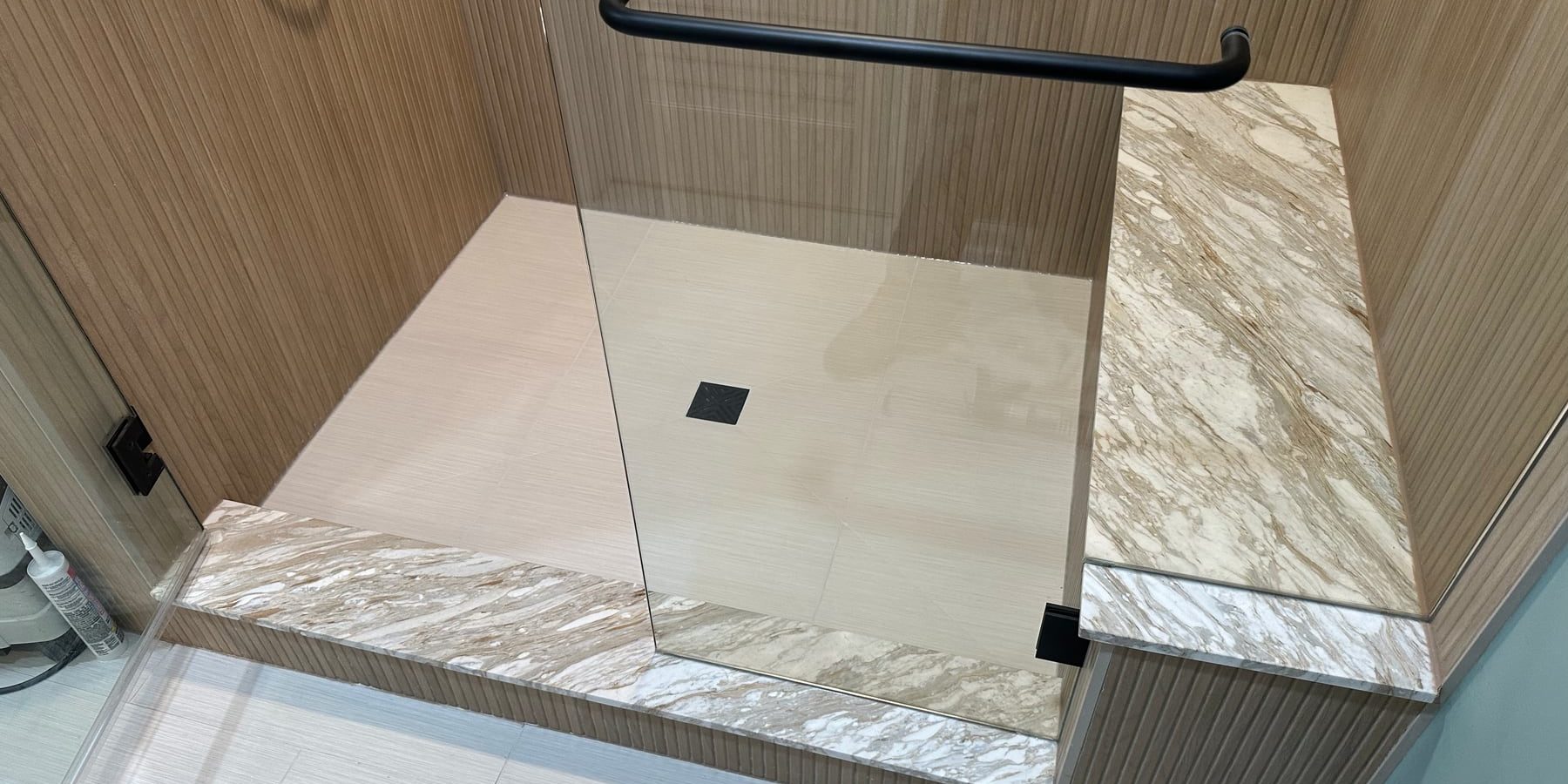
Sound wall tile, natural stone, glass, trim, flooring, & adjacent finishes may remain when they sit outside the failure, can be protected during access, & do not block a dependable connection. Their value makes planning important, but it cannot turn an unstable boundary into a reliable one.
Before removal, document material sizes, layout, veining, shade variation, trim profiles, curb or bench pieces, enclosure attachments, & any spare tile or stone. Separate the inventory into material expected to remain, material that may need specialist handling for access, & material whose condition cannot be known until the connected assembly is opened.
This avoids two opposite mistakes: demolishing sound finishes before the pattern is understood, & promising to preserve a finish that physically crosses the failed support or waterproofing transition.
Regional Proof, Accurately Identified in Highland Park
4NST's documented Highland Park case study began with a penny-round floor divided by extensive cracking. Once the floor was removed, the substrate proved structurally compromised. Reconstruction was limited to the failed shower floor, allowing the wall tile, stone surfaces, & enclosure glass around it to remain.
The address for this work is Highland Park, not Riverwoods. Its relevance here is the relationship between surface geometry & concealed movement: the crack map justified looking below the finish, while a verified stopping point made preservation possible.
See the complete Highland Park failed shower-floor case study.
Three Responsible Outcomes After Diagnosis
Surface or enclosure correction
If the evidence stays at an isolated exposed joint, sweep, track, or enclosure detail & the tiled assembly remains stable, the appropriate correction may not require opening the shower floor. Work outside 4NST's tile scope should be directed to the appropriate enclosure, plumbing, or drain professional.
Focused tile-assembly repair
A focused repair may be responsible when the defect is bounded, support is stable outside it, access is workable, & new water-control work can connect reliably to what remains. The exact scope may involve a drain field, curb, threshold, floor section, lower perimeter, or another defined component.
Reconstruction of the connected portion
A broader scope may be necessary when movement spans multiple areas, cracking repeatedly crosses the proposed edge, the base remains soft, concealed deterioration continues, slope & drain relationships cannot be corrected locally, or no dependable waterproofing termination exists. The connected shower portion may need reconstruction without turning the project into an automatic full-bathroom remodel.
The responsible outcome is the one supported by the assembly's condition, not the smallest opening, the largest project, or the appearance of the finish.
Send a Useful Riverwoods Shower Evidence Set
Begin with one wide photograph showing the complete enclosure. Add close views of the crack route, moving or darkened tile, drain, floor-to-wall perimeter, curb, threshold, jambs, glass line, & every visible water exit. If damage appears below or beside the bathroom, include that location without assuming it is the source.
Provide a short timeline:
- when the first symptom appeared;
- what shower use or spray direction activates it;
- how long it takes for moisture to appear;
- whether any tile clicks, rocks, flexes, or sounds different;
- what grout, caulk, sealer, glass, plumbing, or tile work was attempted;
- how the symptom changed afterward; &
- which tile, stone, glass, or adjacent finishes matter most & whether spare material exists.
This evidence helps qualify whether the problem belongs with 4NST & where an owner-led inspection should begin.
Owner-Operated Diagnosis & Direct Involvement
Since 1982, 4NST has worked throughout Chicago & the North Shore. A Riverwoods inquiry is not passed from an estimator to an outside repair crew. Kristopher receives the history, inspects the tiled assembly, decides where a technically defensible scope begins & ends, & stays involved when the company carries out the repair.
This single line of responsibility is useful when conditions change after material is opened. Kristopher can relate the new finding to the original symptom map & explain whether one piece can be reset, a connection needs more access, a surrounding finish can stay, or another trade should investigate first.
Learn about the owner-operated company, examine the documented 4NST project gallery, or view the complete Chicago & North Shore service area.
Frequently Asked Questions
Can a Riverwoods tile-shower leak be repaired if the wet spot appears far from the crack?
Possibly. Water can travel along backing, framing, a curb, or a floor junction before it becomes visible, so the exit point & the crack may still belong to one connected pattern. Timing, spray direction, movement, nearby transitions, & the condition found between those points determine whether a focused repair can reach a reliable boundary.
What does a crack that continues across several shower tiles or joints indicate?
It can indicate stress or movement beneath more than one finish piece, but the route alone does not identify the concealed cause. Mortar contact, substrate movement, material transitions, drain geometry, slope, & waterproofing details may influence the pattern. Recurrence, looseness, deflection, & moisture behavior determine how strongly the crack supports a broader investigation.
Does a loose or hollow shower tile prove the shower pan has failed?
No. A hollow sound can exist without movement, & one loose tile can result from an isolated bond problem. Concern increases when several pieces move together, grout repeatedly cracks, the floor feels soft, moisture persists, or water escapes the enclosure. The surrounding support & water-control system must be evaluated before the pan is blamed.
When is a focused Riverwoods tile-shower repair responsible?
A focused repair is responsible when the defect has a credible outer edge, stable support remains around it, the failed component is accessible, & new waterproofing can connect dependably to the existing assembly. If movement, deterioration, or water-control failure continues beyond that edge, the scope must expand until those conditions are addressed.
When should a plumber be called instead of a tile-shower specialist?
When water develops without shower operation or points to supply piping, a valve or fixture, blockage, or routine drain service, begin with a licensed plumber or the appropriate drain professional. When use triggers symptoms at the tiled floor, curb, perimeter, or drain transition & the evidence involves bond, support, slope, or waterproofing, a tile-assembly investigation is appropriate. Some cases need coordinated evaluation.
Will Kristopher personally diagnose & work on my Riverwoods shower?
Yes. As 4NST's owner & lead specialist, Kristopher Duschen handles the history review, on-site evaluation, & scope decisions, & he stays involved through work performed by the company. He does not sell the project & hand it off to an outside tile-repair crew.
Start With the Complete Pattern
Describe every place the shower cracks, moves, stays dark, or releases water—even when the clues seem separated. Include timing, prior repair results, wide & close photographs, & the finishes you hope to preserve.
Call 847-446-2029 or send photographs & request a professional shower inspection. Kristopher can use that record to determine whether the next step belongs with the tiled assembly & where the investigation should begin.
4NST is owner-operated from Morton Grove & serves Riverwoods, Chicago, & the North Shore.
Preservation Follows the Technical Boundary
Sound wall tile, natural stone, glass, trim, flooring, & adjacent finishes may remain when they sit outside the failure, can be protected during access, & do not block a dependable connection. Their value makes planning important, but it cannot turn an unstable boundary into a reliable one.
Before removal, document material sizes, layout, veining, shade variation, trim profiles, curb or bench pieces, enclosure attachments, & any spare tile or stone. Separate the inventory into material expected to remain, material that may need specialist handling for access, & material whose condition cannot be known until the connected assembly is opened.
This avoids two opposite mistakes: demolishing sound finishes before the pattern is understood, & promising to preserve a finish that physically crosses the failed support or waterproofing transition.
Regional Proof, Accurately Identified in Highland Park
4NST's documented Highland Park case study began with a penny-round floor divided by extensive cracking. Once the floor was removed, the substrate proved structurally compromised. Reconstruction was limited to the failed shower floor, allowing the wall tile, stone surfaces, & enclosure glass around it to remain.
The address for this work is Highland Park, not Riverwoods. Its relevance here is the relationship between surface geometry & concealed movement: the crack map justified looking below the finish, while a verified stopping point made preservation possible.
See the complete Highland Park failed shower-floor case study.
Three Responsible Outcomes After Diagnosis
Surface or enclosure correction
If the evidence stays at an isolated exposed joint, sweep, track, or enclosure detail & the tiled assembly remains stable, the appropriate correction may not require opening the shower floor. Work outside 4NST's tile scope should be directed to the appropriate enclosure, plumbing, or drain professional.
Focused tile-assembly repair
A focused repair may be responsible when the defect is bounded, support is stable outside it, access is workable, & new water-control work can connect reliably to what remains. The exact scope may involve a drain field, curb, threshold, floor section, lower perimeter, or another defined component.
Reconstruction of the connected portion
A broader scope may be necessary when movement spans multiple areas, cracking repeatedly crosses the proposed edge, the base remains soft, concealed deterioration continues, slope & drain relationships cannot be corrected locally, or no dependable waterproofing termination exists. The connected shower portion may need reconstruction without turning the project into an automatic full-bathroom remodel.
The responsible outcome is the one supported by the assembly's condition, not the smallest opening, the largest project, or the appearance of the finish.
Send a Useful Riverwoods Shower Evidence Set
Begin with one wide photograph showing the complete enclosure. Add close views of the crack route, moving or darkened tile, drain, floor-to-wall perimeter, curb, threshold, jambs, glass line, & every visible water exit. If damage appears below or beside the bathroom, include that location without assuming it is the source.
Provide a short timeline:
- when the first symptom appeared;
- what shower use or spray direction activates it;
- how long it takes for moisture to appear;
- whether any tile clicks, rocks, flexes, or sounds different;
- what grout, caulk, sealer, glass, plumbing, or tile work was attempted;
- how the symptom changed afterward; &
- which tile, stone, glass, or adjacent finishes matter most & whether spare material exists.
This evidence helps qualify whether the problem belongs with 4NST & where an owner-led inspection should begin.
Owner-Operated Diagnosis & Direct Involvement
Since 1982, 4NST has worked throughout Chicago & the North Shore. A Riverwoods inquiry is not passed from an estimator to an outside repair crew. Kristopher receives the history, inspects the tiled assembly, decides where a technically defensible scope begins & ends, & stays involved when the company carries out the repair.
This single line of responsibility is useful when conditions change after material is opened. Kristopher can relate the new finding to the original symptom map & explain whether one piece can be reset, a connection needs more access, a surrounding finish can stay, or another trade should investigate first.
Learn about the owner-operated company, examine the documented 4NST project gallery, or view the complete Chicago & North Shore service area.
Frequently Asked Questions
Can a Riverwoods tile-shower leak be repaired if the wet spot appears far from the crack?
Possibly. Water can travel along backing, framing, a curb, or a floor junction before it becomes visible, so the exit point & the crack may still belong to one connected pattern. Timing, spray direction, movement, nearby transitions, & the condition found between those points determine whether a focused repair can reach a reliable boundary.
What does a crack that continues across several shower tiles or joints indicate?
It can indicate stress or movement beneath more than one finish piece, but the route alone does not identify the concealed cause. Mortar contact, substrate movement, material transitions, drain geometry, slope, & waterproofing details may influence the pattern. Recurrence, looseness, deflection, & moisture behavior determine how strongly the crack supports a broader investigation.
Does a loose or hollow shower tile prove the shower pan has failed?
No. A hollow sound can exist without movement, & one loose tile can result from an isolated bond problem. Concern increases when several pieces move together, grout repeatedly cracks, the floor feels soft, moisture persists, or water escapes the enclosure. The surrounding support & water-control system must be evaluated before the pan is blamed.
When is a focused Riverwoods tile-shower repair responsible?
A focused repair is responsible when the defect has a credible outer edge, stable support remains around it, the failed component is accessible, & new waterproofing can connect dependably to the existing assembly. If movement, deterioration, or water-control failure continues beyond that edge, the scope must expand until those conditions are addressed.
When should a plumber be called instead of a tile-shower specialist?
When water develops without shower operation or points to supply piping, a valve or fixture, blockage, or routine drain service, begin with a licensed plumber or the appropriate drain professional. When use triggers symptoms at the tiled floor, curb, perimeter, or drain transition & the evidence involves bond, support, slope, or waterproofing, a tile-assembly investigation is appropriate. Some cases need coordinated evaluation.
Will Kristopher personally diagnose & work on my Riverwoods shower?
Yes. As 4NST's owner & lead specialist, Kristopher Duschen handles the history review, on-site evaluation, & scope decisions, & he stays involved through work performed by the company. He does not sell the project & hand it off to an outside tile-repair crew.
Start With the Complete Pattern
Describe every place the shower cracks, moves, stays dark, or releases water—even when the clues seem separated. Include timing, prior repair results, wide & close photographs, & the finishes you hope to preserve.
Call 847-446-2029 or send photographs & request a professional shower inspection. Kristopher can use that record to determine whether the next step belongs with the tiled assembly & where the investigation should begin.
4NST is owner-operated from Morton Grove & serves Riverwoods, Chicago, & the North Shore.