
Leaking & Failed Tile Shower Repair in Old Town, Chicago
In an older or previously renovated bathroom, the hardest question is often not “Can this crack be covered?” It is “Which parts of this shower still deserve to stay?” A recurring split through grout or tile may trace movement below a finish worth preserving. A leak may follow a junction created when a newer shower was fitted into earlier construction. The visible defect is the starting point, not the repair plan.
Old Town inquiries are handled directly by Kristopher Duschen, owner & lead specialist at North Shore Tile & Shower Repair. He studies the shower’s renovation history, symptom sequence, material changes, & accessible construction before defining a scope. When stable original or high-value finishes can remain without compromising the repair, preservation is built into the plan. When the surviving assembly contains a known weakness, it is not hidden behind another cosmetic treatment.
Explore 4NST’s tile & shower repair services or request an owner-led shower inspection.
Call 847-446-2029 about an Old Town shower that has developed a repeat crack, unexplained dampness, loose tile, or trouble after an earlier renovation.
Quick Answer: What Should Decide Repair Versus Rebuild in an Old Town Shower?
The stopping point of the failure should decide. Selective work can make sense when investigation finds stable material around a limited defect & a sound place to connect the repaired waterproofing & support. Reconstruction becomes the safer recommendation when movement, moisture damage, or deficient construction continues beyond that boundary. Neither the property’s age nor the value of its tile answers the question by itself.
That distinction protects both sides of the decision: useful material is not discarded merely because it is old, & a defective base is not preserved merely because the finish is attractive.
Read the Bathroom’s Renovation History as Layers
A vintage residence, a condominium conversion, & a recently remodeled bath can each contain several generations of work. The shower may be newer than the room, the room newer than the floor structure, or a replacement pan may meet wall work from an earlier project. Those junctions deserve attention because different materials & methods must still behave as one wet-area assembly.
Three dates are especially useful, even when they are approximate:
- When the building or unit was substantially altered — this helps frame the underlying structure without treating age as a diagnosis.
- When the present shower was constructed — this separates the visible bathroom design from older concealed work.
- When the symptom & each attempted repair appeared — this shows whether grout, sealant, tile, plumbing, or enclosure work changed the behavior.
A newer shower inside an older property is not automatically defective. An older installation is not automatically beyond repair. The history simply helps Kristopher decide where to look & which connections may represent the weakest point.
A Returning Crack Is a Timeline, Not Just a Line
A crack that reappears after repair carries information. Its route, pace, & relationship to use can reveal whether the surface is responding to something below it.
- A split that follows the same joint after fresh grout suggests the joint is recording continuing movement.
- A line crossing several pieces of tile raises questions about support, bond, or a seam underneath.
- Damage that opens only near a curb, threshold, or bench points toward a different junction than a crack radiating from the drain.
- Clicking, rocking, or a hollow response beside the crack can add evidence of lost support.
- Darkening or prolonged dampness along the same route adds a water-behavior question to the movement question.
These observations do not diagnose a specific Old Town property from a photograph. They help determine whether a controlled opening is warranted & where that opening would yield the most useful evidence.
Preservation Triage: Keep, Access, or Replace
Preservation-first repair is a technical decision, not a promise to leave everything untouched.
Keep: Material outside the failure may remain when it is stable, well bonded, serviceable, & compatible with the new work. An intact wall field, stone slab, or glass enclosure can have real design & replacement value.
Access carefully: Some finishes may need temporary removal or protection so the substrate, drain connection, curb, or waterproofing can be reached. Whether glass or stone can be removed safely must be assessed before reuse is offered.
Replace: Material must give way when it conceals deterioration, cannot be separated without damage, or prevents a dependable waterproof connection. Retaining a beautiful surface over an unresolved defect is not preservation; it transfers the risk into the next failure.
Discontinued tile & natural-stone variation make early certainty about matching unrealistic. Salvage, a complementary material, or a purposeful transition may be more credible than promising an invisible patch.
The Known-Weak-Point Rule
A repair boundary is responsible only when the assembly immediately beyond it can support the new work. That means the decision cannot be based solely on the smallest area that can be opened.
Suppose a failed floor meets stable walls & the new waterproofing can be integrated at a sound perimeter. A floor-focused reconstruction may be viable. If the same opening reveals deterioration continuing into the curb, wall base, framing, or adjoining substrate, stopping at the original line would preserve a known weak point. The scope has to expand far enough to remove that weakness & establish a coherent assembly.
This rule also works in the other direction. Evidence confined to an accessible transition does not justify tearing out an entire bathroom simply because the residence is old. The repair should be large enough to become dependable & no larger merely for convenience.
When the Evidence Supports a Focused Scope
Selective work becomes a credible option when the defect can be isolated, the surrounding installation demonstrates stability, & the new waterproofing can terminate at sound construction. The drain & slope must remain functional or be correctable within the opening. Retained tile, stone, glass, & adjacent surfaces must not obstruct access or force the repair to depend on exposed caulk as its primary defense.
The exact scope might center on a floor, drain zone, curb, threshold, bench connection, glass interface, or limited field of loose tile. Those labels describe possible boundaries; inspection determines which one applies.
When the Evidence Requires More Reconstruction
A larger shower scope is appropriate when the conditions refuse to stay local. Examples include movement through more than one plane, widespread hollow or loose finishes, deterioration below the surface, moisture reaching structural or adjoining materials, or waterproofing that cannot be joined reliably inside a limited opening. Repeated patches at different locations can also show that the surviving system—not one isolated joint—is the problem.
“Broader reconstruction” does not automatically mean remodeling the whole bathroom. It means carrying the shower work far enough to remove the connected failure & avoid attaching new materials to an assembly already shown to be unreliable.
When Moisture Appears Somewhere Else
Water does not have to emerge where it entered. A stain at trim, a damp bathroom floor, a mark in an adjoining room, or moisture below the unit may be the end of a concealed path. Record when the evidence appears, whether it follows a particular spray direction, & whether it continues after use. Avoid repeated testing when water is actively reaching another finished area.
A symptom unrelated to shower use may point to a pressurized line, drain, fixture, or another plumbing condition. A licensed plumber or other qualified professional may need to separate that issue from the tiled enclosure. 4NST’s specialty is the tile shower itself: its support, waterproofing, floor, drain interfaces, & containment transitions.
Regional 4NST Proof, Accurately Located
The related project shown on this page is in Highland Park—not Old Town. Its penny-round floor had cracked extensively because the substrate was structurally compromised. 4NST rebuilt that failed floor while keeping the surrounding wall tile, stone surfaces, & glass enclosure.
That documented result illustrates the same decision standard used here: preserve sound elements, remove the failed construction, & stop only at a boundary capable of supporting the repair.
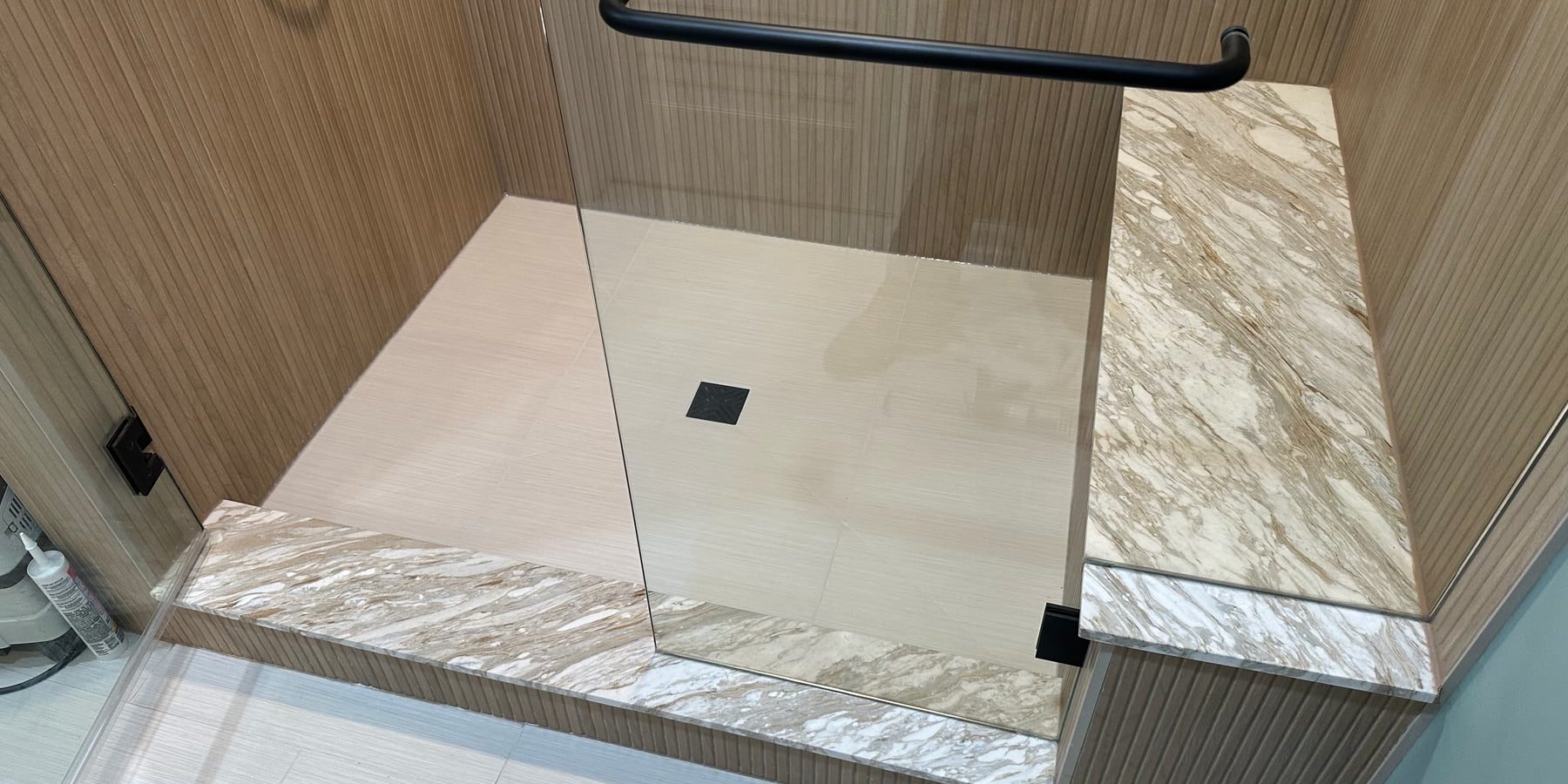
See the complete Highland Park failed shower-floor case study.
Is This the Kind of Shower Problem 4NST Evaluates?
A good-fit inquiry usually involves a tiled assembly rather than ordinary cleaning or decoration. It may concern a crack that repeatedly returns; tile that clicks, rocks, sounds hollow, or lifts; dampness at a threshold; water tied to shower use; a failed curb, floor, bench, drain zone, or wall base; or a previous repair that changed the appearance without resolving the behavior.
Natural stone & custom glass do not disqualify the project, but they make access & material planning more important. Likewise, damage outside the enclosure does not prove that every part of the shower has failed. The purpose of the evaluation is to connect the symptom to a defensible repair boundary.
Slow drainage by itself, a blockage, or water appearing while the shower is unused may call for a plumber or drain specialist first.
Build a Useful Project Record Before Calling
The most useful first message is a short history rather than a single close-up. Send:
- One photograph that shows the whole shower & enclosure.
- Detail images of each crack, open joint, moving tile, stain, curb, threshold, or drain-area concern.
- A view of any effect outside the shower or below the bathroom.
- The approximate shower-renovation date &, if known, what was changed.
- A simple timeline: when the symptom starts, how long the shower has run, & when it disappears.
- Notes about prior grout, caulk, sealer, plumbing, tile, or glass work & whether it altered the symptom.
- The finishes you most want to retain & any spare matching material available.
Leave the assembly undisturbed for the initial conversation. Pulling tile or opening a wall can erase clues & create damage before the repair boundary is understood.
The Person Who Diagnoses the Shower Stays Involved
4NST is owner-operated. Kristopher leads the evaluation & remains directly involved during the repair; tile-shower work is not handed from a salesperson to a subcontracted repair crew. That continuity matters when opening the assembly changes what is known & the scope must be reassessed against the same preservation-versus-reliability standard.
North Shore Tile & Shower Repair has served Chicago & the North Shore since 1982. Read about the owner-operated company & browse the 4NST project gallery.
Old Town Is a Service Area, Not a Second Business Location
The company is based in Morton Grove & serves Old Town as part of its Chicago & North Shore territory. The page does not create or imply an Old Town office. Review the complete Chicago & North Shore service area.
Frequently Asked Questions
What determines whether an Old Town shower can be repaired selectively?
A selective scope requires a limited defect, stable construction around it, workable access, & a sound place to join the repaired waterproofing & support. If movement, deterioration, or deficient construction continues past the proposed edge, the opening must expand until the work can end at a reliable boundary.
Can a recurring shower crack be only a grout problem?
It can be when the joint material itself is the entire defect, but repetition raises a deeper question. A crack that returns along the same route, crosses tile, or appears with movement, hollow areas, or dampness may be recording trouble in the bond, substrate, transition, or another concealed layer. Covering that evidence again does not resolve its cause.
How can a condominium conversion or earlier renovation affect the diagnosis?
Different phases of construction may meet inside one bathroom. The visible shower, concealed support, plumbing transitions, & surrounding structure may not have been installed at the same time. Knowing the renovation sequence helps identify those junctions, but the condition found at the shower—not the building category—determines the repair.
Is preserving vintage tile always the right choice?
No. Vintage or difficult-to-match material is worth protecting only when it is stable & can remain beside a dependable repair. Tile, stone, or glass that blocks necessary access, conceals deterioration, or forces an unreliable waterproofing connection may need removal. Preservation should reduce needless loss without preserving the failure itself.
What should I document before requesting an Old Town shower inspection?
Provide a full-shower image, close views of each symptom, the approximate renovation history, & a timeline of when water or movement appears. Include earlier grout, caulk, tile, glass, or plumbing work; damage outside the enclosure; finishes you hope to retain; & whether matching material is available.
Will the owner remain involved in my Old Town tile-shower repair?
Yes. Kristopher Duschen is the owner & lead specialist. He conducts the evaluation & remains directly involved in the work rather than transferring the tile-shower repair to a subcontracted crew.
Request an Owner-Led Old Town Shower Inspection
Describe the sequence, not just the stain: where the problem begins, when it appears, what renovation or patching came before it, & which finishes matter most to you.
Call 847-446-2029 or request a professional shower inspection.
Morton Grove-based 4NST serves Old Town, Chicago, & the North Shore.