
Leaking & Failed Tile Shower Repair in Lincoln Park, Chicago
A leaking or repeatedly cracking tile shower needs more than another surface treatment. Water may be escaping at a curb, enclosure, bench, drain, plumbing penetration, or transition hidden beneath an otherwise attractive finish. Recurring cracks may indicate movement or a failed supporting layer rather than defective grout alone.
North Shore Tile & Shower Repair provides owner-operated shower diagnosis & repair for Lincoln Park homeowners & condominium owners. Kristopher Duschen personally evaluates the symptom pattern & remains directly involved in the work. The goal is to identify the actual failure, preserve sound tile, stone, & glass when a focused repair can be integrated reliably, & explain when broader reconstruction is the responsible choice.
Review our tile & shower repair services or request an owner-led shower inspection.
Quick Answer: Can a Failed Lincoln Park Shower Be Repaired Without Remodeling the Entire Bathroom?
Often, yes. A focused repair may be appropriate when the failure is limited, the surrounding assembly remains stable, & new waterproofing or supporting materials can be connected reliably. A broader shower rebuild may be necessary when movement, moisture, or installation defects extend across the floor, curb, walls, or concealed structure. The existing tile’s appearance & value matter, but the verified condition beneath it determines what can responsibly remain.
Why the Visible Defect May Not Be the Actual Failure
Tile, stone, grout, & caulk are the visible finish of a connected wet-area assembly. They are not the complete water-management system. A useful diagnosis considers:
- The visible finish — cracking, separation, discoloration, loose material, & slow-drying areas provide clues.
- The bond layer — insufficient coverage, debonding, or incompatible materials can allow tile to move.
- The substrate — an unstable, damaged, or improperly prepared supporting layer can cause cracks to return through new grout or tile.
- The waterproofing system — the shower pan, wall waterproofing, drain connection, & transitions must work together.
- The surrounding interfaces — curbs, thresholds, benches, glass tracks, jambs, plumbing penetrations, & changes of plane can become entry or exit points for water.
Replacing grout or caulk may be appropriate maintenance when the underlying assembly is sound. It will not stabilize a moving substrate, rebuild a failed waterproofing transition, or correct an improperly constructed shower floor.
Historic Homes, Condominiums, & Renovated Bathrooms Require Different Questions
A Lincoln Park inquiry may involve an older home, a condominium, or a bathroom that was renovated long after the original structure was built. Those descriptions do not prove why a shower failed. They do affect the questions that should be asked before recommending a repair.
In an older structure, the evaluation may need to distinguish normal building variation from active movement within the shower assembly. In a renovated bathroom, recurring cracks can raise questions about the substrate, framing, material transitions, or how new waterproofing was connected. In a condominium, the first visible symptom may appear outside the shower, in an adjacent finish, or below the bathroom even though the water entered elsewhere.
Age alone does not make a shower defective, & a recent renovation does not prove that it was built correctly. The symptom pattern, material condition, & accessible evidence should guide the diagnosis.
Recurring Cracks After a Bathroom Renovation
A crack that returns along the same line deserves attention, especially when it is accompanied by loose tile, floor movement, dampness, or separation at nearby transitions. Possible causes can include:
- Movement in the substrate or supporting structure
- Inadequate material coverage or loss of bond
- An improperly placed or missing movement joint
- A weak transition between different materials or planes
- An unstable curb, bench, threshold, or shower floor
- Moisture-related deterioration beneath the finished surface
- A previous repair that addressed the visible crack without correcting its cause
The crack pattern can be more informative than the crack width. A line that crosses multiple tiles, returns after regrouting, or follows a structural transition may point to a deeper condition. Opening a limited area is sometimes necessary to confirm what the surface evidence suggests.
When Water Appears Outside the Shower or Below the Bathroom
The place where water becomes visible is not always where it entered the assembly. Water can travel along framing, backer materials, waterproofing, fasteners, plumbing penetrations, or floor transitions before appearing at a baseboard, doorway, adjacent ceiling, or unit below.
Useful diagnostic details include:
- Whether leakage begins immediately or only after several minutes
- Whether it occurs only when spray reaches the door, curb, bench, or one wall
- Whether the symptom continues after the water is turned off
- Whether the shower floor, curb, or tile visibly moves
- Whether the drain or supply plumbing has already been evaluated
- Whether recaulking, regrouting, sealing, or enclosure work changed the symptom
- Whether moisture appears in the same place every time
A blocked drain, pressurized plumbing leak, or unrelated supply problem may require a licensed plumber or drain specialist. North Shore Tile & Shower Repair focuses on the tiled shower assembly, its substrate, waterproofing, & critical transitions.
Preserving High-Value Tile, Stone, & Glass
An attractive finish should not be discarded automatically, but it also should not be preserved at the expense of a dependable repair. Kristopher evaluates which materials remain stable, which areas must be opened, & whether the new work can connect reliably to what stays.
A preservation-focused scope may consider:
- Whether surrounding wall tile remains firmly bonded
- Whether natural stone can be protected, salvaged, or matched acceptably
- Whether glass can remain safely in place or be removed & reinstalled
- Whether a repair can terminate at a technically reliable boundary
- Whether waterproofing can be integrated without relying on exposed sealant alone
- Whether the drain, slope, curb, & nearby transitions remain serviceable
- Whether concealed damage extends beyond the visible failure
Exact matching is not promised before the existing material is identified. Older tile, batch-variable products, & natural stone may require salvage, a complementary material, or a deliberately defined transition.
Owner-Led Diagnosis Before the Scope Is Chosen
North Shore Tile & Shower Repair is owner-operated. Kristopher evaluates the shower & remains directly involved rather than handing the repair to a subcontracted crew.
The evaluation begins with the symptom:
- Where does water, cracking, separation, or discoloration appear?
- When did it begin, & has it changed?
- Does the problem occur during use, afterward, or while the shower dries?
- What repairs or surface treatments have already been attempted?
- Which finishes are stable, & which ones move or sound hollow?
- What tile, stone, glass, or surrounding work is most important to preserve?
- Can a limited opening create a reliable repair boundary?
- Is broader reconstruction necessary to avoid leaving a compromised assembly behind?
The smallest possible repair is not automatically the best repair. A full bathroom remodel is not automatically necessary either. The scope should follow the actual failure.
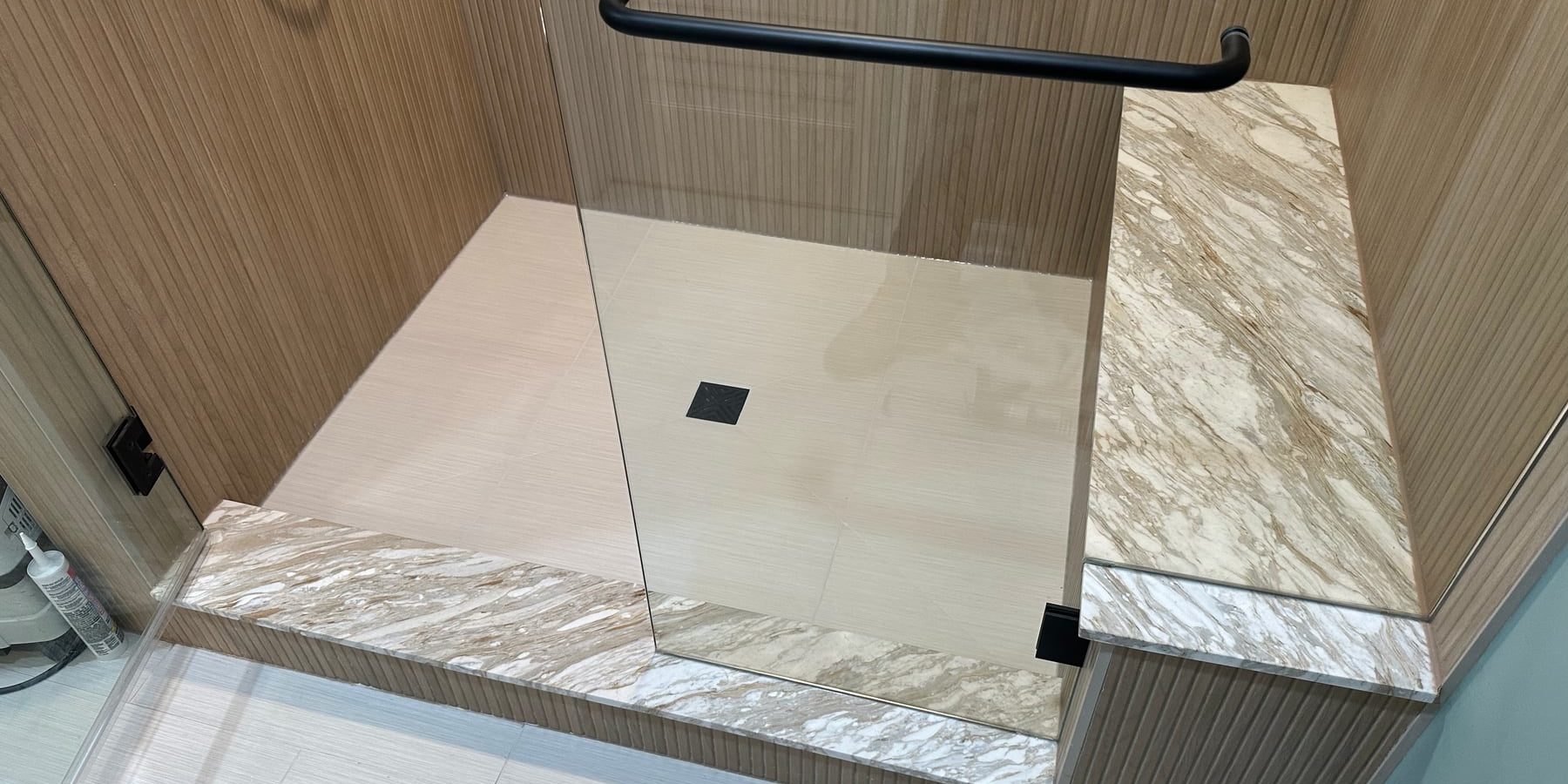
Documented 4NST project: failed shower-floor repair in Highland Park, Illinois, with surrounding stone & glass preserved.
Documented 4NST Proof: Rebuilding a Failed Floor While Preserving Surrounding Finishes
In a documented Highland Park project, extensive cracking across a penny-round shower floor revealed a structurally compromised substrate. 4NST removed & rebuilt the failed floor while preserving the surrounding wall tile, stone surfaces, & glass enclosure.
This project occurred in Highland Park, not Lincoln Park. It is included as documented 4NST proof of the diagnostic & preservation-first approach described here.
See the complete Highland Park failed shower-floor case study.
When a Focused Shower Repair May Be Appropriate
A selective repair may be responsible when:
- The affected area is clearly defined & accessible
- Surrounding tile & substrate remain stable
- The water path or movement source can be corrected
- New waterproofing can be connected coherently
- The drain, slope, & adjoining transitions remain serviceable
- Material removal can stop at a dependable boundary
- Preserved finishes will not weaken the repaired assembly
Depending on the verified condition, a focused scope may involve a shower-floor area, curb, threshold, bench, perimeter transition, drain connection, glass-enclosure interface, or limited section of loose tile.
When Broader Reconstruction May Be Necessary
A larger shower repair or rebuild may be the responsible recommendation when:
- Cracking or movement affects multiple parts of the shower
- The floor, curb, bench, or wall substrate is broadly unstable
- The shower pan or waterproofing has failed across the assembly
- Concealed materials are deteriorated
- Moisture has reached framing, subfloor, or adjoining finishes
- A dependable waterproof connection cannot be created within a limited opening
- Previous cosmetic or localized repairs repeatedly failed
- Preserving the existing installation would leave a known weak point behind
A broader scope should be recommended because the remaining assembly cannot support a reliable repair—not simply because the bathroom is older or the finishes are valuable.
Tile-Shower Problems Evaluated in Lincoln Park
North Shore Tile & Shower Repair evaluates conditions involving:
- Water escaping from a tiled shower or enclosure
- Recurring shower-floor or wall-tile cracks
- Loose, hollow, raised, or moving tile
- Failed shower floors, curbs, benches, thresholds, or substrates
- Shower-pan & waterproofing failures
- Drain-area & plumbing-penetration transitions
- Repeated caulk separation at changes of plane
- Natural-stone moisture & material-transition concerns
- Water appearing in an adjacent room or below the bathroom
- Unsuccessful regrouting, recaulking, sealing, or limited repair work
- Selective reconstruction intended to preserve sound surrounding finishes
No single symptom proves the extent of the repair. The combination of location, timing, movement, moisture behavior, & concealed condition determines the appropriate boundary.
What to Share When You Contact 4NST
For a more useful first conversation, include:
- Photos showing the entire shower & enclosure
- Close photos of the crack, separation, loose tile, stain, or damaged area
- Photos of any moisture or finish damage outside or below the bathroom
- Where the symptom first appears & how long the shower has been running
- Whether directing spray at one wall, the door, curb, or bench changes it
- Whether tile moves, sounds hollow, or has cracked more than once
- Details of previous grout, caulk, sealer, plumbing, glass, or repair work
- Which tile, stone, glass, or surrounding finishes you hope to preserve
- Whether spare matching material is available
Do not remove tile or open walls simply to prepare for the call. The undisturbed symptom pattern can provide useful diagnostic evidence.
Why Work Directly With North Shore Tile
North Shore Tile & Shower Repair has served Chicago & the North Shore since 1982. The positioning is practical rather than promotional:
- Kristopher leads the diagnosis & remains involved in the repair
- Tile-shower work is not assigned to subcontracted repair crews
- Recommendations begin with the failure condition, not a preset remodeling package
- Focused repair is considered when it can be integrated responsibly
- Sound tile, stone, glass, & surrounding finishes are preserved when practical
- Material limitations & reasons for broader reconstruction are explained before work proceeds
Learn more about the owner-operated company & view the 4NST project gallery.
Serving Lincoln Park & the Chicago Area
North Shore Tile & Shower Repair is based in Morton Grove & serves Lincoln Park, other Chicago neighborhoods, & communities across the North Shore. Review the complete Chicago & North Shore service area.
Frequently Asked Questions
Can a leaking tile shower in Lincoln Park be repaired without remodeling the entire bathroom?
Often, yes. A focused repair may be appropriate when the failure is limited, the surrounding assembly remains stable, & waterproofing can be reconnected reliably. Widespread movement, concealed deterioration, or broad shower-pan or substrate failure may require a larger shower repair or rebuild. The verified condition—not the age or appearance of the bathroom—should determine the scope.
Why do cracks keep returning after a shower has been regrouted?
Recurring cracks can indicate movement, loss of bond, an unstable substrate, a weak material transition, or a failed component beneath the finished surface. Regrouting may replace the visible material without correcting the force that caused it to crack. The crack pattern & nearby movement or moisture should be evaluated before another surface repair.
Does water on a ceiling below mean the entire shower pan must be replaced?
Not necessarily. The visible water may originate at the pan, drain, curb, enclosure, plumbing penetration, or another transition & travel before appearing below. Symptom timing, controlled observations, surface movement, & sometimes a limited opening help determine whether a focused repair is possible or broader reconstruction is needed.
Can custom tile, natural stone, or shower glass be preserved during a repair?
Sometimes. Preservation depends on where the failure ends, whether surrounding materials remain stable, & whether the affected area can be accessed without creating an unreliable transition. Material availability, safe glass handling, & the ability to integrate new waterproofing must be evaluated before any finish is promised to remain.
What information should I provide when requesting a Lincoln Park shower inspection?
Share photos of the entire shower, the exact symptom, & any damage outside or below the bathroom. Explain when the problem appears, whether spray direction changes it, what repairs have already been attempted, whether tile moves or sounds hollow, & which finishes you hope to preserve. Those details help qualify the problem before the inspection.
Who evaluates & performs tile-shower repairs in Lincoln Park?
Kristopher Duschen, the owner & lead specialist, personally evaluates the shower & remains directly involved in the work. North Shore Tile & Shower Repair does not send tile-shower repairs to subcontracted crews.
If a Lincoln Park tile shower is leaking, repeatedly cracking, staying damp, or failing after grout, caulk, or sealer work, start with the symptom & the assembly—not another cosmetic repair. Include where the symptom appears, when it occurs, what has already been repaired, & photos of the shower & affected area.
Based in Morton Grove & serving Lincoln Park, Chicago, & the North Shore.