
Leaking & Failed Tile Shower Repair in Deerfield, Illinois
A Deerfield tile shower that leaks again after recaulking, develops a familiar crack after regrouting, or has tile that loosens in the same area needs a diagnosis before another surface treatment. The repeating symptom may be the visible result of movement, insufficient support, an unreliable waterproofing transition, a drain-interface problem, or a different water path. It does not identify the concealed cause by itself.
North Shore Tile & Shower Repair is owner-operated. Kristopher Duschen evaluates the symptom history, the tiled assembly, & the finishes that matter before defining a repair boundary. When a focused repair can reconnect sound support & waterproofing, stable tile, stone, glass, & adjoining finishes may remain. When the failure crosses that boundary, he explains why a wider reconstruction is the responsible option.
Review 4NST's tile & shower repair services or send photographs & the repair history for an owner-led inspection.
A Recurring Symptom Is New Evidence
A previous repair is not just history; its outcome helps organize the next evaluation. Record what was changed, where it was applied, how long the symptom stopped, & whether it returned in the same place.
The crack reopened along the same line. That pattern can shift attention from the grout itself toward movement in the tile, setting layer, backing, floor support, curb, or plane change.
The leak stopped briefly, then returned. A new bead of sealant may have blocked one exit while moisture found another route. The temporary change is useful, but it does not prove which concealed component failed.
The wet area moved. A different exit location after surface work can indicate that the visible opening was part of the route rather than the point where water first entered.
Nothing changed. If a treatment had no effect, the proposed cause may have been wrong, the repair may not have reached the failure, or a plumbing or enclosure condition may be involved.
Do not remove the fresh material merely to prepare for an inspection. Its location & condition may preserve evidence about movement & moisture behavior.
Build the Failure History Before Choosing the Scope
Kristopher begins with a short sequence rather than a demolition size.
- First appearance: Where did the crack, loose tile, darkening, odor, or water first become noticeable?
- Activation: Does the symptom begin with spray at the door, only after several minutes of use, after the shower is off, or even while the shower is idle?
- Prior work: Was grout, caulk, sealer, glass, plumbing, tile, or part of the pan changed? What happened afterward?
- Movement: Does any tile click, deflect, sound hollow, or repeatedly separate from a neighboring surface?
- Expansion: Is the condition isolated, or is it advancing across the floor, curb, lower wall, bathroom floor, or an adjacent ceiling?
The sequence helps distinguish a maintenance issue from a connected assembly failure. It also prevents an attractive but unrelated finish from dictating the repair before the water & movement pattern are understood.
Separate Four Systems That Can Produce One Wet Spot
Enclosure containment
Doors, sweeps, jambs, glass channels, curb tops, & spray direction can allow water to escape even when the buried tiled assembly remains sound. An enclosure-only route should be tested as a competing explanation, not assumed from the wet location.
Plumbing & drainage
Supply piping, valves, fixtures, traps, blockages, & other plumbing conditions may require a licensed plumber. Moisture that appears while the shower is idle or follows a plumbing event changes the order of investigation. 4NST does not present tile replacement as a solution for a plumbing defect.
Surface joints & finish material
Grout, flexible sealant, & suitable sealer have legitimate roles. They can correct an isolated joint or help an appropriate finish resist absorption & staining. They cannot add structural support, remake a shower pan, change improper slope, or reconnect waterproofing at the drain.
The tiled wet-area assembly
The shower floor, substrate, bond, slope, waterproofing, drain interface, curb, penetrations, & plane changes must operate as a connected system. Recurring cracks, movement, loose tile, or moisture that persists beyond an isolated joint can justify closer evaluation of that system.
Diagnosis Before Scope Protects More Than the Shower
In a higher-value home, the repair decision may affect natural stone, frameless glass, custom trim, matched tile, cabinetry, heated floors, or adjacent finished spaces. Their cost & appearance make preservation important, but they cannot establish that a small repair is technically sound.
The useful order is:
- Identify the most likely failure route.
- Determine whether the affected assembly is stable outside that route.
- Locate a dependable place to connect new support & waterproofing to what remains.
- Evaluate what must be moved or protected to reach that connection.
- Compare a focused repair with the consequences of leaving a connected defect in place.
This sequence resists two expensive mistakes: removing sound finishes before the failure is understood, & protecting visible finishes so aggressively that the concealed water-control system cannot be repaired reliably.
Create a Finish Inventory, Not a Preservation Promise
Before opening the assembly, list the elements whose loss would affect the project: wall tile, stone slabs, bench or curb caps, glass panels, hardware, trim, flooring, cabinetry, & matching spare material. Photograph their condition & note which pieces physically cross the suspected repair boundary.
Then classify each item.
- Outside the likely boundary: It may remain untouched if access & protection are practical.
- Removable for access: It may be handled & reinstalled, but the plan should disclose breakage, fit, & trade-coordination risks.
- Part of the failed connection: It may need removal even when it looks sound at the surface.
- Unavailable or variable: Older tile & natural stone may not have an exact match, which can influence layout & scope.
Preservation is a technical result, not a pre-inspection guarantee. A stone curb, wall field, or glass enclosure should remain only when doing so does not force the new repair to terminate against unstable or unconnectable material.
Focused Repair or Broader Rebuild?
A focused repair becomes more credible when the evidence points to one bounded area, the surrounding assembly is stable, access is workable, & the new waterproofing & support can join sound material. Depending on the condition, that boundary might involve a drain field, curb, threshold, floor section, or lower-perimeter area.
A broader rebuild becomes more credible when:
- cracks or loose material span several connected components;
- the floor or curb moves beyond one isolated spot;
- moisture appears along multiple boundaries;
- concealed deterioration extends past the proposed opening;
- slope, support, pan, & drain-interface problems overlap; or
- there is no dependable termination for new waterproofing.
The decision is not based on the home's value, the price of the finish, or a preference for large or small projects. It follows the extent of failure & whether the remaining assembly can support a durable connection.
A Controlled Opening Should Answer a Defined Question
Sometimes surface observations narrow the possibilities but cannot verify what is concealed. In that situation, a limited opening should have a purpose: confirm the condition of the substrate, trace a transition, inspect the drain connection, or determine whether deterioration stops at a proposed boundary.
Opening material without a defined question can enlarge damage without improving the diagnosis. Homeowners should avoid removing tile or cutting adjacent ceilings before the initial conversation unless an appropriate professional has directed emergency access. Photographing the undisturbed condition, the previous repair, & the visible exit point usually provides a better starting record.
Nearby Proof, Accurately Located in Highland Park
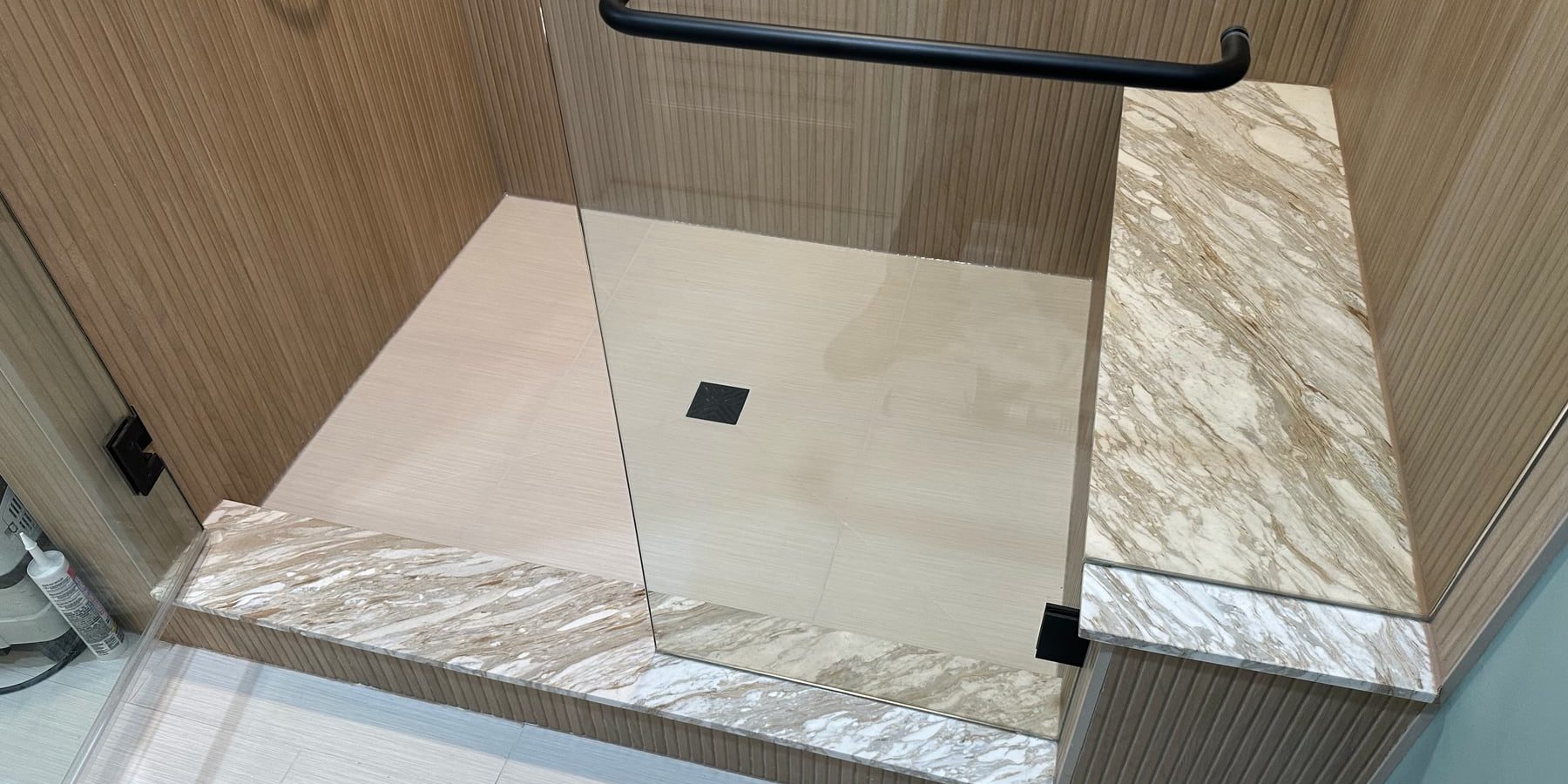
A documented 4NST project in Highland Park shows how crack geometry can lead beyond a cosmetic repair. Extensive cracking crossed a penny-round shower floor, & removal confirmed that the substrate had been structurally compromised. The failed floor was rebuilt while the surrounding wall tile, stone surfaces, & glass enclosure were preserved.
That project is in Highland Park, not Deerfield. It is included here as nearby evidence of the method: diagnose the support beneath the finish, establish where the failure ends, & retain sound surrounding materials when the new work can connect reliably.
See the complete Highland Park failed shower-floor case study.
Prepare a Useful Deerfield Shower Record
Before contacting 4NST, collect a concise set of facts:
- one wide photograph showing the entire shower;
- close photographs of the floor, drain, curb, lower corners, glass line, & reported damage;
- the date or sequence when the symptom first appeared;
- the interval between shower use & visible moisture;
- locations of clicking, movement, darkening, recurring cracks, or loose tile;
- every prior grout, caulk, sealer, glass, plumbing, or tile repair & its result;
- finishes that should be preserved & any matching material already available; &
- whether water is reaching another room or finished ceiling.
If active water is reaching another finished space, stop using the shower rather than repeating a test. If moisture appears independently of shower use or suggests a pressurized plumbing source, contact a licensed plumber or the appropriate professional.
Owner-Operated Diagnosis & Repair
4NST has served Chicago & the North Shore since 1982. The relevant difference for failure work is continuity: Kristopher hears the history, evaluates the shower, explains the scope, & remains directly involved when 4NST performs the tile-shower repair. The project is not sold by one person & transferred to a subcontracted tile-repair crew.
That continuity matters when the answer is conditional. Kristopher can explain why a previous treatment did not address movement, why a valued finish may remain, why access changes the proposed boundary, or why a plumber should investigate before tile work begins.
Learn more about the owner-operated company, view the documented 4NST project gallery, or check the current Chicago & North Shore service territory.
Frequently Asked Questions
Why can a Deerfield shower leak return after new caulk or grout?
The visible joint may have been an exit point rather than the origin of the water. New caulk or grout can temporarily block that exit without correcting movement, inadequate support, a failed waterproofing transition, a drain-interface problem, enclosure escape, or a plumbing source. The way the symptom changed after the repair becomes evidence for the next diagnosis.
Does a recurring shower-floor crack prove the substrate has failed?
No. A recurring crack raises concern about movement or support, but the crack alone does not identify the concealed cause. Its direction, length, return after repair, relationship to the drain or curb, nearby tile movement, & moisture pattern determine whether a controlled opening or broader investigation is justified.
Can sound stone, glass, & wall tile remain during a shower repair?
Sometimes. Preservation is practical when the failure is bounded, the surrounding assembly is stable, access is workable, & new support & waterproofing can connect reliably to what remains. A finish may need removal when it crosses the failed connection or blocks the only dependable repair boundary.
How does 4NST decide between a focused repair & a broader rebuild?
The decision follows the extent of movement, moisture, concealed deterioration, & waterproofing discontinuity. A focused repair needs an isolated fault, workable access, stable surrounding material, & a sound termination for the new assembly. Connected failures or an unreliable termination can require broader reconstruction.
Should a plumber inspect the problem before a tile-shower specialist?
Call a licensed plumber or the appropriate professional when moisture appears while the shower is idle, a pressurized supply or fixture is suspected, or the problem involves blockage or plumbing drainage. Symptoms activated by shower use & centered on the tiled floor, curb, perimeter, waterproofing, or drain interface fit a tile-assembly evaluation. Some problems require both disciplines.
Will Kristopher personally evaluate my Deerfield shower?
Yes. Kristopher Duschen is the owner & lead specialist. He evaluates the symptom history & repair boundary & remains directly involved when North Shore Tile & Shower Repair performs the work. Tile-shower repairs are not transferred to a subcontracted crew after the initial conversation.
Start With the Failure History, Not Another Surface Fix
If a leak, crack, loose tile, or damp area has returned, preserve the evidence & document what changed after the last repair.
Call 847-446-2029 or send photographs & request a professional shower inspection. Include when the symptom appears, what has already been tried, whether anything moves, & which finishes matter most.
4NST is based in Morton Grove & serves Deerfield, Chicago, & the North Shore.