
Leaking Shower Base & Tile Repair in Glenview, Illinois
Water at the outside edge of a shower does not always come from the nearest visible crack. It may travel from a curb, floor-to-wall transition, drain area, enclosure connection, or failed floor or pan assembly before it reaches the bathroom floor, baseboard, adjacent room, or ceiling below.
North Shore Tile & Shower Repair provides owner-operated tile shower diagnosis & repair in Glenview & across Chicago’s North Shore. Kristopher Duschen personally evaluates the symptoms & remains directly involved in the work. The goal is to identify the likely water path, recommend the smallest responsible scope, & preserve sound tile, stone, glass, & surrounding finishes when a dependable repair is practical.
Call 847-446-2029 or request an owner-led shower inspection.
Water at the outside edge of a shower does not always come from the nearest visible crack. It may travel from a curb, floor-to-wall transition, drain area, enclosure connection, or failed floor or pan assembly before it reaches the bathroom floor, baseboard, adjacent room, or ceiling below.
North Shore Tile & Shower Repair provides owner-operated tile shower diagnosis & repair in Glenview & across Chicago’s North Shore. Kristopher Duschen personally evaluates the symptoms & remains directly involved in the work. The goal is to identify the likely water path, recommend the smallest responsible scope, & preserve sound tile, stone, glass, & surrounding finishes when a dependable repair is practical.
Call 847-446-2029 or request an owner-led shower inspection.
Quick Answer: Can a Leaking Shower Base Be Repaired?
Often, yes. A shower-base leak may be repairable without remodeling the entire bathroom when the failure is limited, accessible, & surrounded by stable materials. A focused repair must address the actual water-containment problem—not simply cover the nearest grout or caulk joint.
A broader shower-floor repair or rebuild may be necessary when tile moves across a larger area, moisture damage extends beyond one transition, the substrate or pan has failed, or new waterproofing cannot be joined reliably to the remaining assembly. The correct scope follows the evidence found during evaluation.
Start With Where & When the Water Appears
The location & timing of a symptom can narrow the possibilities:
- Water that appears only when spray reaches a door, jamb, or curb may involve the enclosure or a lower transition.
- Moisture that develops after several minutes of use may involve the floor, drain, perimeter, or waterproofing assembly.
- Water that appears after the shower is turned off may have traveled within the assembly before becoming visible.
- Dampness at the same outside corner can suggest a repeatable migration path rather than a random surface gap.
- Water that appears while the shower has not been used may involve supply or drain plumbing & may require a licensed plumber.
These are diagnostic clues, not conclusions. The wet spot shows where water became visible; it does not automatically reveal where the water first escaped containment.
Why Shower-Base Leaks Are Easy to Misdiagnose
The shower base is not one part. It is a connected assembly that includes the finished floor, drain, supporting surface, waterproofing or pan, lower wall transitions, curb or threshold, & enclosure details. Water can enter at one point & follow a surface, seam, framing member, or concealed layer before it appears somewhere else.
Grout & caulk remain important finish & joint materials, but they cannot stabilize a moving floor, correct improper slope, restore a failed drain connection, or replace damaged waterproofing. A repair that begins & ends with the nearest visible crack can miss the condition that created the symptom.
Learn more about 4NST’s tile & shower repair services.
Warning Signs at the Floor, Curb, & Lower Perimeter
Conditions worth evaluating include:
- Water on the bathroom floor beside the curb or threshold
- Swollen baseboard, discolored flooring, peeling paint, or a ceiling mark below
- Grout that repeatedly cracks at the shower floor or lower wall
- Caulk that repeatedly separates at a curb, jamb, glass track, or floor-to-wall transition
- Shower-floor or curb tile that rocks, clicks, sounds hollow with other symptoms, or feels unstable
- Persistent darkening, dampness, or odor after the shower should have dried
- Cracks or movement concentrated near the drain
- A prior regrouting or recaulking job that improved appearance but did not stop the leak
No single symptom establishes the full repair scope. Repeated patterns & combinations—such as loose tile with recurring cracks or water outside the enclosure—provide stronger reasons to evaluate the assembly beneath the finish.
What to Do Before the Inspection
- Stop using the shower when water is reaching finished surfaces. Continued wetting can enlarge the affected area.
- Dry accessible exterior surfaces. Normal ventilation, a fan, or a dehumidifier may help protect nearby finishes while the shower remains out of service.
- Photograph the whole shower & the symptom. Include the floor, curb, drain, door area, & where water becomes visible.
- Record the timing. Note whether the symptom starts immediately, after several minutes, after use, or when the shower is not running.
- Record prior work. Regrouting, recaulking, plumbing repairs, door work, or earlier leak repairs can affect the diagnosis.
- Avoid sealing every joint before evaluation. Blanket caulking can redirect water or conceal evidence without fixing the underlying failure.
Do not remove tile or open walls solely to prepare for the first conversation. Existing conditions can provide useful diagnostic evidence.
Owner-Led Diagnosis Before a Repair Scope
North Shore Tile & Shower Repair has served Chicago & the North Shore since 1982. Kristopher, the owner & lead specialist, evaluates projects & remains directly involved rather than sending a subcontracted shower-repair crew.
The evaluation considers:
- Symptom history — where the issue began, when water appears, & whether it has changed.
- Lower-assembly pattern — whether the concern is isolated to an enclosure detail, transition, drain area, floor section, or a wider assembly.
- Movement & bond — recurring cracks, loose tile, hollow areas with other symptoms, or visible deflection.
- Water-management details — slope, curb, threshold, perimeter, drain, penetrations, & accessible waterproofing conditions.
- Surrounding materials — which tile, stone, glass, & adjacent finishes appear sound & worth preserving.
- Repair boundary — whether a focused repair can be integrated reliably or whether broader reconstruction is necessary.
The recommendation should explain what the evidence supports & what remains uncertain. It should not begin with a predetermined regrouting package or a full-remodel sales pitch.
Quick Answer: Can a Leaking Shower Base Be Repaired?
Often, yes. A shower-base leak may be repairable without remodeling the entire bathroom when the failure is limited, accessible, & surrounded by stable materials. A focused repair must address the actual water-containment problem—not simply cover the nearest grout or caulk joint.
A broader shower-floor repair or rebuild may be necessary when tile moves across a larger area, moisture damage extends beyond one transition, the substrate or pan has failed, or new waterproofing cannot be joined reliably to the remaining assembly. The correct scope follows the evidence found during evaluation.
Start With Where & When the Water Appears
The location & timing of a symptom can narrow the possibilities:
- Water that appears only when spray reaches a door, jamb, or curb may involve the enclosure or a lower transition.
- Moisture that develops after several minutes of use may involve the floor, drain, perimeter, or waterproofing assembly.
- Water that appears after the shower is turned off may have traveled within the assembly before becoming visible.
- Dampness at the same outside corner can suggest a repeatable migration path rather than a random surface gap.
- Water that appears while the shower has not been used may involve supply or drain plumbing & may require a licensed plumber.
These are diagnostic clues, not conclusions. The wet spot shows where water became visible; it does not automatically reveal where the water first escaped containment.
Why Shower-Base Leaks Are Easy to Misdiagnose
The shower base is not one part. It is a connected assembly that includes the finished floor, drain, supporting surface, waterproofing or pan, lower wall transitions, curb or threshold, & enclosure details. Water can enter at one point & follow a surface, seam, framing member, or concealed layer before it appears somewhere else.
Grout & caulk remain important finish & joint materials, but they cannot stabilize a moving floor, correct improper slope, restore a failed drain connection, or replace damaged waterproofing. A repair that begins & ends with the nearest visible crack can miss the condition that created the symptom.
Learn more about 4NST’s tile & shower repair services.
Warning Signs at the Floor, Curb, & Lower Perimeter
Conditions worth evaluating include:
- Water on the bathroom floor beside the curb or threshold
- Swollen baseboard, discolored flooring, peeling paint, or a ceiling mark below
- Grout that repeatedly cracks at the shower floor or lower wall
- Caulk that repeatedly separates at a curb, jamb, glass track, or floor-to-wall transition
- Shower-floor or curb tile that rocks, clicks, sounds hollow with other symptoms, or feels unstable
- Persistent darkening, dampness, or odor after the shower should have dried
- Cracks or movement concentrated near the drain
- A prior regrouting or recaulking job that improved appearance but did not stop the leak
No single symptom establishes the full repair scope. Repeated patterns & combinations—such as loose tile with recurring cracks or water outside the enclosure—provide stronger reasons to evaluate the assembly beneath the finish.
What to Do Before the Inspection
- Stop using the shower when water is reaching finished surfaces. Continued wetting can enlarge the affected area.
- Dry accessible exterior surfaces. Normal ventilation, a fan, or a dehumidifier may help protect nearby finishes while the shower remains out of service.
- Photograph the whole shower & the symptom. Include the floor, curb, drain, door area, & where water becomes visible.
- Record the timing. Note whether the symptom starts immediately, after several minutes, after use, or when the shower is not running.
- Record prior work. Regrouting, recaulking, plumbing repairs, door work, or earlier leak repairs can affect the diagnosis.
- Avoid sealing every joint before evaluation. Blanket caulking can redirect water or conceal evidence without fixing the underlying failure.
Do not remove tile or open walls solely to prepare for the first conversation. Existing conditions can provide useful diagnostic evidence.
Owner-Led Diagnosis Before a Repair Scope
North Shore Tile & Shower Repair has served Chicago & the North Shore since 1982. Kristopher, the owner & lead specialist, evaluates projects & remains directly involved rather than sending a subcontracted shower-repair crew.
The evaluation considers:
- Symptom history — where the issue began, when water appears, & whether it has changed.
- Lower-assembly pattern — whether the concern is isolated to an enclosure detail, transition, drain area, floor section, or a wider assembly.
- Movement & bond — recurring cracks, loose tile, hollow areas with other symptoms, or visible deflection.
- Water-management details — slope, curb, threshold, perimeter, drain, penetrations, & accessible waterproofing conditions.
- Surrounding materials — which tile, stone, glass, & adjacent finishes appear sound & worth preserving.
- Repair boundary — whether a focused repair can be integrated reliably or whether broader reconstruction is necessary.
The recommendation should explain what the evidence supports & what remains uncertain. It should not begin with a predetermined regrouting package or a full-remodel sales pitch.
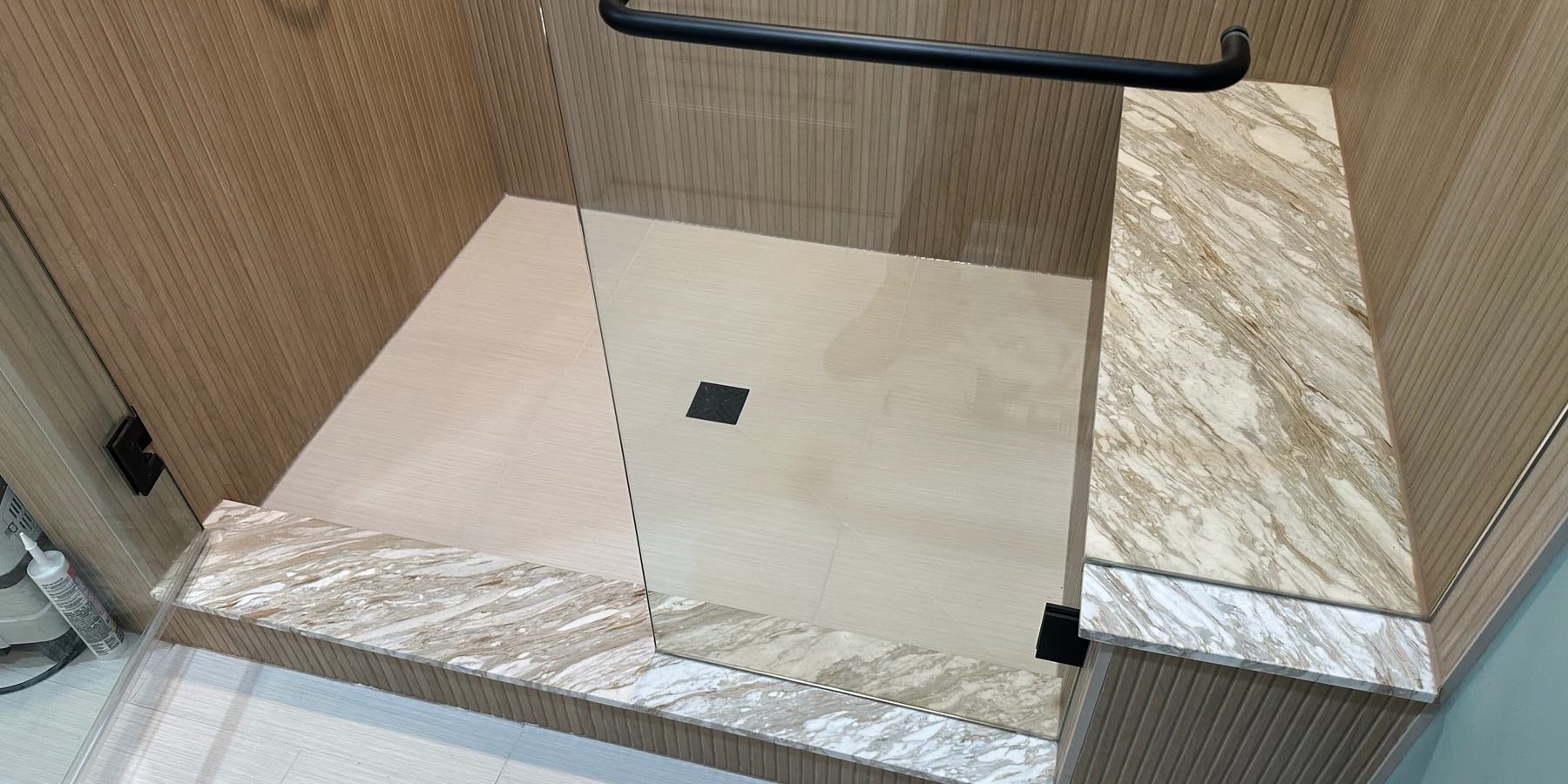
Verified Glenview Experience: A Badly Leaking Shower Base
Mike Bonamasso is identified on 4NST’s published testimonial pages as a Glenview customer. In that account, he described 26 years of commercial interior contracting experience & work performed in two bathrooms at his home.
“They repaired a badly leaking shower base … and re-grouted, caulked, and cleaned all of the existing tile work.”
Mike reported that the existing tilework was brought to a like-new condition & that the work avoided total replacement. His experience supports a practical repair-versus-replacement principle: preserve what is sound when a responsible repair can address the actual problem.
Read the longer published 4NST customer testimonial.
This testimonial is genuine Glenview proof, but it is not a technical case study. The published account does not establish the precise failure source, materials, date or repair boundary, so those details are not claimed.
Focused Repair or Broader Rebuild?
A focused repair may be appropriate when
- The water path or damaged area can be isolated
- Surrounding floor & wall tile remain stable
- The supporting material is serviceable outside the failed area
- The drain, slope, curb, & perimeter can remain functional
- The failed section can be opened & reconnected without creating an unreliable transition
- Existing tile, stone, or glass can be preserved or replaced acceptably
Depending on the verified condition, a focused scope may include repairing a lower transition, resetting salvageable tile, rebuilding a defined curb or floor section, renewing appropriate joints, or correcting a confirmed enclosure-related water path.
Broader reconstruction may be appropriate when
- Movement or loose tile extends across a larger floor or wall area
- Moisture damage affects multiple transitions or concealed materials
- The pan, waterproofing, drain connection, or substrate has failed broadly
- The floor feels soft, unstable, or visibly deflects
- Existing construction prevents a reliable connection between new & remaining waterproofing
- Previous surface repairs have repeatedly failed
Not every shower-base leak requires a full bathroom remodel. Not every attractive shower can be repaired through one small opening. The responsible scope is the one that addresses the failure without removing sound work unnecessarily or leaving an assembly that cannot manage water reliably.
Preserving Existing Tile, Stone, & Glass
A lower-shower failure does not automatically mean every surrounding finish must be discarded. When the damaged area can be accessed & integrated correctly, a focused repair may preserve wall tile, stone thresholds, glass, & adjacent bathroom finishes.
Preservation cannot be promised before the concealed condition is known. Older or naturally variable tile may be difficult to match, & some components may need removal to create a dependable repair. Kristopher’s role is to explain which materials appear sound, which are at risk, & why the proposed boundary is technically responsible.
Tile Shower Problems Evaluated in Glenview
4NST evaluates & repairs conditions including:
- Leaking shower bases & lower tiled assemblies
- Water escaping at curbs, thresholds, jambs, & glass-door areas
- Failed floor-to-wall & perimeter transitions
- Shower-floor, curb, & lower-wall tile that is loose, hollow, cracked, or moving
- Recurring grout or caulk failure associated with a deeper condition
- Drain-area & penetration concerns involving the tiled assembly
- Failed or improperly installed shower floors, pans, substrates, or waterproofing
- Localized repair intended to preserve stable surrounding materials
- Broader reconstruction when a dependable limited repair is not possible
If the only symptom is a clogged or slow drain, a supply leak, or water appearing when the shower is not used, a licensed plumber or drain service may be the appropriate first call. North Shore Tile’s specialty is the tiled shower assembly & its water-containment transitions.
Related 4NST Project: Failed Shower Floor in Highland Park
A documented Highland Park case study shows extensive cracking across a penny-round shower floor where the substrate had been structurally compromised. The failed floor was rebuilt while the surrounding wall tile, stone, & glass were preserved.
This project is in Highland Park, not Glenview. It shows how a floor-level structural failure can sometimes be addressed while sound finishes outside the repair boundary remain in place.
See the Highland Park failed shower-floor case study.
What to Share When You Contact 4NST
The following details help qualify a Glenview shower-repair inquiry:
- A full view of the shower & close views of the floor, curb, drain, & symptom area
- The exact location where water, staining, movement, or cracking appears
- Whether the symptom occurs during use, after use, or when the shower is off
- Whether tile moves, clicks, sounds hollow, or has cracked more than once
- The approximate age of the shower, if known
- Any previous regrouting, recaulking, plumbing, enclosure, or leak-repair work
- Which existing tile, stone, glass, or nearby finishes you hope to preserve
- Whether the shower can remain unused while it is evaluated & repaired
Share photographs if requested & supported by the contact method. Photos help establish context but do not replace an on-site inspection.
Why Work Directly With North Shore Tile
- Serving Chicago & the North Shore since 1982
- Owner-led evaluation & direct involvement
- No subcontracted shower-repair crews
- Specialized focus on leaking & failed tile showers
- Diagnosis before a repair or rebuild recommendation
- Preservation of sound finishes when technically practical
- A clearly explained repair boundary based on existing conditions
Serving Glenview & Chicago’s North Shore
North Shore Tile & Shower Repair is based in Morton Grove & serves Glenview, Chicago, & surrounding North Shore communities.
Review the complete 4NST service area or browse the 4NST project gallery.
Frequently Asked Questions
Can a leaking shower base in Glenview be repaired without remodeling the entire bathroom?
Often, yes. When the failure is limited, accessible, & surrounded by stable materials, a focused repair may preserve existing tile, stone, glass, & nearby finishes. Widespread pan, waterproofing, substrate, or moisture damage may require broader reconstruction.
Why can water appear outside a shower base when no nearby crack is obvious?
Water can enter at one location & travel along a curb, transition, seam, concealed surface, or lower shower assembly before becoming visible. The wet spot is an important clue, but the symptom location is not always the original failure point.
Will regrouting or recaulking the shower perimeter stop the leak?
Only when a deteriorated surface joint or enclosure seal is the complete problem. New grout or caulk cannot correct improper slope, a moving substrate, loose tile, a failed drain connection, or damaged waterproofing beneath the finish.
What signs suggest a deeper shower-floor or pan failure?
Concern increases when multiple tiles move, grout cracks repeatedly across a pattern, the floor feels soft, moisture appears in more than one area, or water damages flooring, trim, walls, or a ceiling below. These signs require evaluation before another surface repair is attempted.
Can existing wall tile, stone, & shower glass remain during a shower-base repair?
Sometimes. Preservation depends on the failure location, the condition of surrounding materials, access to the damaged area, & whether new work can be integrated reliably. No material should be promised for reuse before the concealed condition is evaluated.
Who evaluates & performs tile shower repairs in Glenview?
Kristopher Duschen, the owner & lead specialist, evaluates projects & remains directly involved in the work. North Shore Tile & Shower Repair does not send tile & shower repairs to subcontracted crews.
Request an Owner-Led Shower Inspection in Glenview
If water is appearing beside or below your shower, the base feels unstable, or lower grout & caulk keep failing, start with a diagnosis of the actual water path.
Call 847-446-2029 or request a professional shower inspection. Include where & when the symptom appears, any prior repair history, & photographs if requested.