
Leaking & Failed Tile Shower Repair in Kenilworth, Illinois
A tile or natural-stone shower can look too valuable to disturb & still be failing beneath the finish. A crack can return through new grout. Moisture can darken a curb or appear beyond the enclosure. A loose piece can reveal movement that sealer will never correct. When the surrounding stone, glass, or tile is worth protecting, the answer is not automatic demolition—& it is not another cosmetic treatment made without a diagnosis.
North Shore Tile & Shower Repair begins with the failure pattern. Owner Kristopher Duschen evaluates what activates the symptom, which parts of the assembly move, what previous work changed, & whether a dependable repair can end at sound construction. He stays directly involved if the evidence leads to tile-shower work. The objective is to preserve unaffected finishes when the technical boundary permits it & to explain when preservation would compromise the correction.
Explore 4NST's tile & shower repair services or send photographs & the symptom history for an owner-led inspection.
Quick Answer: Can a Failed Shower Be Repaired Without Losing Every Finish?
Sometimes. A selective repair is realistic when the failed area can be reached, removed, & rebuilt to stable support & a trustworthy waterproofing connection. Tile, stone, or glass outside that boundary may remain if it is sound & can be protected during access. A limited scope is not responsible when movement, deterioration, or disconnected waterproofing continues beyond the proposed edge. The correct boundary comes from evidence, not from the price or appearance of the finish.
Preserve the Evidence Before Trying to Preserve the Material
A repeated crack, damp edge, or leak interval is part of the diagnostic record. Covering it immediately with grout, caulk, sealer, or a loose tile can make the shower look better while erasing clues about movement & water travel.
Before another treatment, record:
- The first symptom — Photograph where the crack, discoloration, looseness, or escaped water began.
- The activation pattern — Note whether it develops with direct spray, only after several minutes, after shutoff, or while the shower is unused.
- The recurrence history — List earlier grout, caulk, sealer, glass, plumbing, or tile work & how long the improvement lasted.
- The physical response — Report clicking, rocking, softness, deflection, or a joint that opens under ordinary pressure.
- The exit location — Photograph moisture at the curb, bathroom floor, adjacent room, or ceiling below without assuming that location is the entry point.
This record can distinguish a worn exposed joint from a concealed assembly that is moving or releasing water.
A Premium Finish Does Not Define the Failure Beneath It
Stone type, tile price, & glass design matter to the preservation plan, but they do not establish whether the base is stable or the waterproofing is continuous. A visually refined shower still depends on ordinary fundamentals: firm support, adequate bond, compatible movement details, correct slope, reliable waterproofing transitions, & a sound drain connection.
That distinction prevents two costly assumptions. The first is that an attractive or relatively recent installation must be structurally sound. The second is that valuable finishes automatically require total demolition when one component fails. Diagnosis should test both ideas rather than accept either one.
Read a Recurring Crack as a Map
The route of a crack can be more informative than its width. A straight line may follow a board joint, material transition, patch edge, or framing change. A line near the drain may redirect attention to support, mortar contact, slope, or the drain field. Separation along a curb or plane change can involve movement where components meet. A network of cracks accompanied by loose pieces or deflection carries different weight from one dry, isolated hairline.
Fresh grout can fill the visible gap, but it cannot stiffen a flexing base, restore missing bond, or reconnect buried waterproofing. If the same line returns, the history should be treated as evidence that the original repair boundary may have stopped at the surface.
Moisture Location & Moisture Source Are Different Facts
Water at the outside of a curb can begin at the door, jamb, curb top, penetration, wall return, shower floor, or another connected detail. A stain beyond the bathroom can be an exit point after moisture traveled along backing, framing, or a floor junction. A darkened stone edge may reflect absorption, slow drying, a failed connection, or water arriving from elsewhere.
Kristopher compares the visible location with timing, spray direction, drain behavior, movement, & prior repair history. One wet spot does not prove that the complete pan has failed, & it does not prove that surface caulk is the answer.
If moisture appears while the shower is idle, a supply or fixture condition may require a licensed plumber. A blockage or ordinary drain-clearing problem also belongs with the appropriate drain professional. 4NST's specialty is the tile assembly: finish, bond, support, slope, waterproofing, curb, perimeter, & the tiled system's relationship to the drain.
Four Boundaries Control a Preservation-Focused Repair
1. Failure boundary
The defective support, bond, waterproofing, or transition must have an identifiable outer edge. If the problem continues through adjoining planes, a narrow opening cannot truthfully be described as a complete repair.
2. Access boundary
The failed component must be reachable without destroying the very connection the new work needs. A small defect behind a slab, curb cap, fixed glass panel, or unavailable trim can require a wider access plan than its visible size suggests.
3. Waterproofing boundary
New water-control work needs a dependable way to join what remains. Exposed caulk is not a substitute for continuity inside the assembly. If no compatible, stable termination exists, the repair must expand until one is reached.
4. Finish boundary
Material outside the work zone must be firm enough to stay & practical to protect. Natural stone can vary; older tile may have no exact match; glass may require specialized removal & reinstallation outside 4NST's scope. Those facts influence design & sequencing, but they cannot move the technical edge of the failure.
A Controlled Opening Should Answer a Defined Question
Some showers provide enough evidence to reject another surface repair but not enough to select the final reconstruction boundary. A deliberate opening can reveal mortar coverage, support, moisture effects, waterproofing conditions, & whether the adjoining assembly offers a sound connection.
The opening should be placed because a particular finding will change the plan. It may confirm that one floor zone can be isolated, show that deterioration continues under an adjacent finish, or reveal that a drain, curb, or wall transition cannot be left in service. Opening material without a diagnostic question creates damage without necessarily creating clarity.
Build a Finish Inventory Before Removal
Preservation is easier to evaluate when every important component is identified before access begins. Record the tile & stone types, trim profiles, curb or bench pieces, enclosure configuration, adjoining floor, & any spare material in storage. Photograph veining, shade variation, edge details, & the way glass meets the tile.
Then separate the inventory into three categories:
- Expected to remain — Sound material clearly outside the suspected work zone.
- May require access or specialist handling — Glass, slab pieces, caps, trim, or fixtures that block the repair path.
- Unknown until opened — Material directly connected to concealed support or waterproofing whose condition cannot be confirmed from the surface.
This is more honest than promising that every finish will survive. It also creates options if an exact match does not exist: salvage where practical, use available spare material, or plan a deliberate complementary transition after the technical scope is known.
Repair, Expand, or Rebuild the Connected Portion
A limited repair earns its place when the failure is local, access is workable, & new support & waterproofing can join stable construction. The scope may involve a defined floor zone, drain area, curb, threshold, or lower-perimeter section. “Selective” means the boundary has been supported by findings; it does not mean removing the smallest possible amount regardless of the condition.
The scope should expand when movement crosses the proposed edge, the base remains soft or poorly bonded, deterioration continues into adjoining layers, slope cannot be corrected locally, or waterproofing cannot be joined dependably. The connected shower portion may need reconstruction even if nearby finishes remain visually attractive. A larger tile-shower repair is still different from assuming that the entire bathroom requires remodeling.
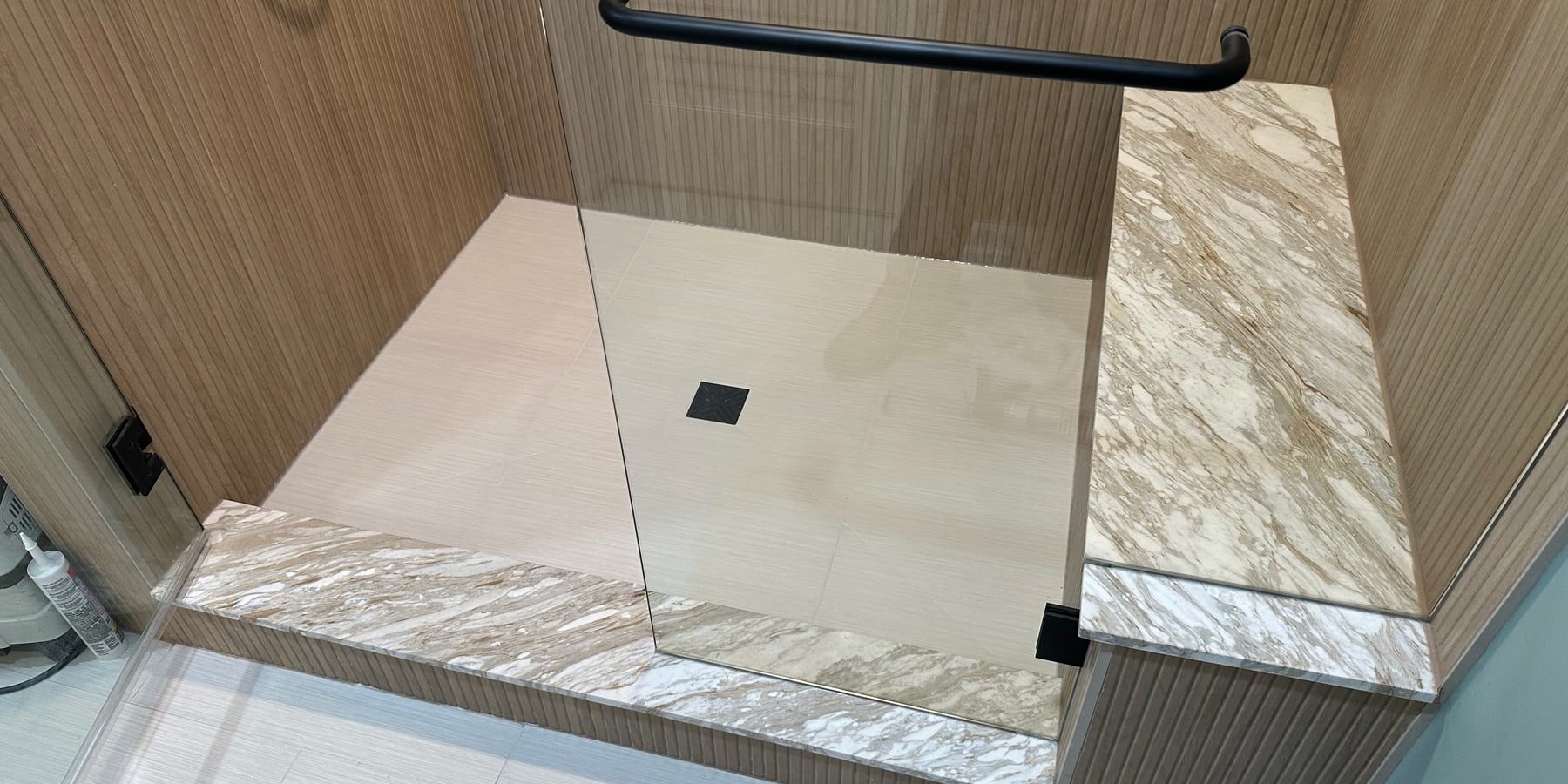
Regional Proof, Clearly Identified: Highland Park Shower-Floor Recovery
4NST has documented a Highland Park shower whose penny-round floor carried extensive cracking. Removal exposed a structurally compromised substrate. The failed shower floor was reconstructed while surrounding wall tile, stone surfaces, & the glass enclosure were retained.
That installation is in Highland Park—not Kenilworth. It appears here as verified regional evidence of the diagnostic principle: recurring cracks can identify a failure beneath the finish, & preservation can be successful when the defect has a sound, accessible boundary.
See the complete Highland Park failed shower-floor case study.
What Owner-Led Diagnosis Changes
4NST has served Chicago & the North Shore since 1982. Kristopher is the person who hears the history, evaluates the shower, develops the tile-assembly scope, & stays involved in the work. The project is not handed from a sales appointment to a subcontracted tile-repair crew.
That continuity matters when conditions beneath the finish require a decision. The same person can explain why a piece can remain, why an access route must change, why the repair needs to continue farther, or why a plumber or other specialist should address a separate condition first.
Read about the owner-operated company & review the documented 4NST project gallery.
Send a Useful Kenilworth Shower Brief
Start with one wide image showing the complete enclosure. Add close photographs of the crack, floor, drain, curb, jambs, lower wall, & any affected surface outside the shower. Include a short timeline: when the symptom began, what activates it, what was repaired previously, & how quickly it returned.
Identify anything that clicks, flexes, rocks, or stays dark. List the tile, stone, glass, or adjoining finishes that matter most, & mention any spare tile or fabrication remnants you have. Do not remove a piece merely to request an inspection; leave the evidence undisturbed unless an active leak requires immediate action by the appropriate professional.
4NST operates from Morton Grove & serves Kenilworth along with other North Shore & Chicago communities. Review the complete Chicago & North Shore service area.
Frequently Asked Questions
Can a Kenilworth tile-shower leak be repaired without replacing all the stone or glass?
Possibly. Sound finishes outside the failed zone may remain when the defect is accessible & new support & waterproofing can connect reliably to stable construction. Stone, glass, trim, & the route needed to reach the failure must be evaluated before preservation can be promised.
Why does the same grout crack keep returning after it is repaired?
A recurring crack can indicate movement, weak support, incomplete bond, or stress at a concealed transition. New grout fills the exposed line but cannot correct those underlying conditions. The crack's route, nearby loose material, physical response, & repair history help determine where investigation should begin.
Does expensive tile or natural stone make a selective shower repair more likely?
No. Finish value makes careful planning worthwhile, but it does not create a sound repair boundary. A selective repair is appropriate only when the failure can be isolated, reached, & reconnected to stable support & waterproofing. Valuable material may influence access & finish decisions, not the technical requirements.
What must be verified before 4NST recommends a partial shower repair?
The defect needs a credible outer edge, the failed component must be accessible, & the new work needs a dependable connection to what remains. Nearby tile, stone, substrate, slope, drain relationships, & waterproofing transitions also must support the proposed boundary. If they do not, the scope has to expand.
Should I call a plumber or a tile-shower specialist first?
Water that appears while the shower is idle, a pressurized supply leak, fixture problem, blockage, or ordinary drain-clearing issue points toward a licensed plumber or the appropriate drain professional. Symptoms activated by shower use & centered on tile, bond, support, slope, waterproofing, the curb, perimeter, or drain interface fit a tile-assembly evaluation. Some problems require both disciplines.
Will Kristopher personally diagnose & work on my Kenilworth shower?
Yes. Kristopher Duschen is the owner & lead specialist. He reviews the symptom history, evaluates the tile-shower assembly, develops the repair scope, & stays directly involved when 4NST performs the work. The project is not transferred to a subcontracted tile-repair crew after the initial conversation.
Start With the Failure Pattern & the Finishes Worth Protecting
Describe what the shower does, when it happens, what earlier work changed, & which materials matter most. That information gives Kristopher a better starting point than another unsupported promise to seal or replace the visible joint.
Call 847-446-2029 or send photographs & request a professional shower inspection. Include the wide & close views, the recurrence timeline, & a list of tile, stone, glass, or adjacent finishes you hope to preserve.
4NST is owner-operated from Morton Grove & serves Kenilworth, Chicago, & the North Shore.