
Tile Shower Leak & Failure Repair in Glencoe, Illinois
Water at a curb corner, damp trim outside the enclosure, recurring caulk separation, or a stain below the bathroom can all point to a leaking tile shower. They do not automatically identify where the water entered the assembly. A dependable recommendation starts by tracing the symptom & testing the likely water path—not by covering every joint with another layer of caulk.
North Shore Tile & Shower Repair provides owner-operated tile-shower diagnosis & repair in Glencoe & across Chicago’s North Shore. Kristopher Duschen, the owner & lead specialist, evaluates the shower & remains directly involved in the work. There is no subcontracted repair crew. The objective is to correct the actual failure & preserve sound tile, stone, glass, & surrounding finishes when a focused repair is technically responsible.
Call 847-446-2029 or request an owner-led shower inspection.
Quick Answer: Is a Curb-Corner Leak Always a Caulk Problem?
No. Failed caulk can allow water to escape, but the same visible symptom can result from curb slope, a door or track end, a fastener or penetration, a failed wall-to-curb transition, movement beneath the tile, or water migrating from another part of the shower.
If water is reaching finished surfaces, stop using the shower, dry the accessible area, take photos, & note exactly when & where the moisture appears. Avoid caulking the entire enclosure before the pattern is evaluated. A broad surface application can change the path & hide evidence without correcting the failed detail.
Read the Pattern Before Opening the Shower
The place that becomes wet is evidence, not necessarily the source. Water can travel along a curb, behind a wall finish, beneath tile, across framing, or through a transition before becoming visible.
Useful diagnostic observations include:
- Direction: Does water appear only when spray reaches the door, jamb, or curb?
- Timing: Does it show immediately, after several minutes, or only after the shower is turned off?
- Location: Is the symptom at one track end, one curb corner, the adjacent floor, a baseboard, a wall, or a ceiling below?
- Recurrence: Did new grout or caulk change the symptom temporarily, or did the same leak return?
- Movement: Is any tile loose, hollow, cracked, raised, or moving under normal use?
- Drying: Does one joint or tile area stay dark, damp, or musty longer than the rest of the shower?
These clues help distinguish water escaping around an enclosure from moisture moving within a failed tiled assembly. They also help identify when a plumbing concern should be evaluated separately.
Why Curbs, Stone, & Glass Transitions Need to Be Evaluated Together
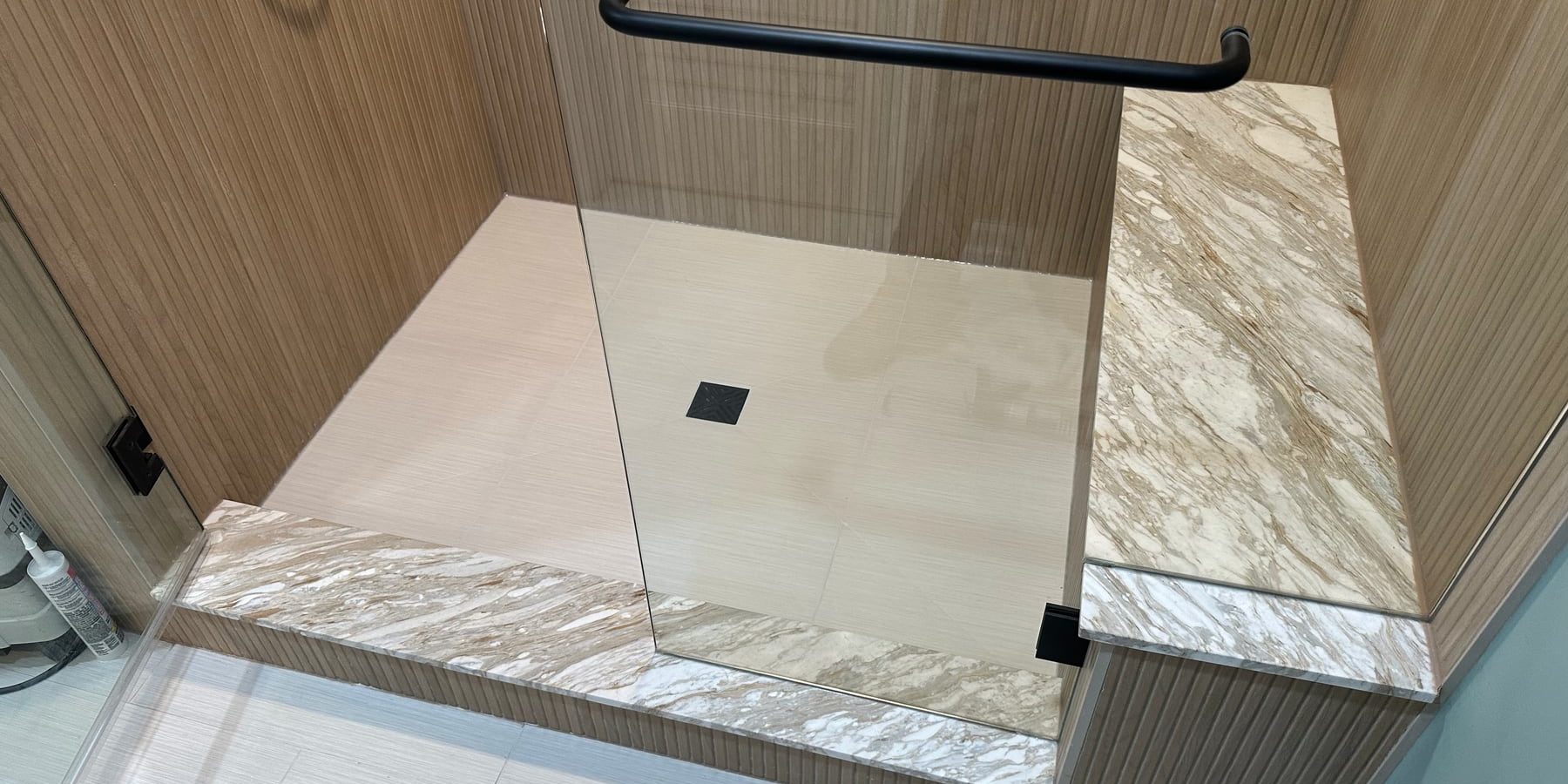
A shower curb is more than a tiled ledge. It meets the floor, walls, waterproofing, threshold material, jambs, & often a glass enclosure. A weakness at one connection can redirect water toward another. New sealant at the visible corner cannot correct an improperly sloped curb, a moving substrate, an unreliable penetration, or a waterproofing detail that was never integrated correctly.
The enclosure matters too. Water that escapes only when spray is directed at a door or track may involve containment or drainage at the enclosure. Water that appears after longer use, returns despite enclosure work, or travels below or beside the shower may point to a different path. The repair scope should follow the evidence rather than assuming every curb-corner symptom has the same cause.
Grout Sealer Is Not a Replacement for Waterproofing
Grout & many natural-stone surfaces can absorb moisture. A suitable sealer may help reduce absorption or staining in the material it is designed to treat, but it does not rebuild a failed shower pan, stabilize loose tile, correct movement, restore slope, or reconnect damaged waterproofing.
That distinction is important in a well-finished bathroom. Applying more product to the surface may change how water beads without resolving where the water is traveling. If the shower leaks, repeatedly cracks, or remains wet in one area, the assembly needs diagnosis before sealer is treated as the solution.
Preservation Matters, but It Must Follow the Evidence
Glencoe has a well-documented architectural & preservation tradition. That does not mean every Glencoe bathroom is historic, & 4NST does not assume a home’s age, designer, or materials. It does make one repair question especially relevant: can the failed portion be corrected without sacrificing sound work around it?
A shower may include natural-stone slabs, carefully aligned tile, a finished bench or threshold, custom glass, surrounding millwork, or material that is difficult to match. Before recommending demolition, Kristopher considers whether the failure is isolated, whether the surrounding assembly is stable, & whether a reliable repair can be integrated into what remains.
Preservation is not a promise to save every finish. Concealed deterioration, unavailable matching material, unsafe removal, or broadly failed waterproofing can make a wider repair necessary. The responsible goal is to avoid needless demolition without protecting finishes at the expense of a dependable shower assembly.
Owner-Led Diagnosis, Not a Predetermined Package
North Shore Tile & Shower Repair has worked on leaky showers across Chicago’s North Shore since 1982. Kristopher leads the inspection & stays directly involved rather than handing the work to a subcontracted repair crew.
The evaluation considers:
- Where & when the symptom appears
- Whether spray direction changes the result
- The pattern of cracking, separation, looseness, or movement
- The curb, drain, perimeter, bench, threshold, penetrations, & enclosure
- The condition of adjacent tile, stone, glass, flooring, trim, & other finishes
- Any prior regrouting, recaulking, plumbing, enclosure, or leak-repair work
- Whether the smallest technically responsible repair can be integrated reliably
Learn more about 4NST’s tile & shower repair services & owner-operated approach.
Focused Repair or Broader Reconstruction?
A focused repair may be appropriate when:
- The failure is limited to a clearly defined area
- Surrounding tile & substrate remain stable
- The damaged portion can be accessed without creating an unreliable transition
- Waterproofing & setting materials can be integrated correctly
- The repair resolves the water path or movement rather than masking it
- Existing stone, tile, glass, or nearby finishes can remain without weakening the repair
Broader reconstruction may be necessary when:
- Multiple areas show movement, chronic moisture, or recurring cracks
- The shower pan, substrate, curb, or waterproofing has failed broadly
- Framing or subfloor deterioration is present
- Tile cannot be removed safely enough to establish a dependable repair boundary
- Previous limited repairs repeatedly failed
- Preserving the existing installation would leave an unreliable assembly
Not every leaking shower requires a full bathroom remodel. Not every attractive shower can be saved with surface work. The recommendation should explain which condition applies & why.
Nearby Project Proof, Labeled Accurately
In a documented Highland Park project, widespread cracking through a penny-round shower floor revealed a structurally compromised substrate. 4NST removed & rebuilt the failed floor while preserving the surrounding wall tile, stone surfaces, & glass enclosure.
This project occurred in Highland Park, not Glencoe. It is included as nearby North Shore proof of the diagnostic & preservation-first approach described on this page.
See the complete Highland Park failed-shower-floor case study.
Tile-Shower Problems Evaluated in Glencoe
North Shore Tile & Shower Repair evaluates conditions such as:
- Water escaping at a curb, jamb, glass-door track, or enclosure corner
- Moisture appearing on flooring, trim, an adjacent wall, or a ceiling below
- Repeated caulk separation at curbs, benches, thresholds, or changes of plane
- Recurring grout cracks or cracking that follows a wider pattern
- Loose, hollow, raised, or moving wall or floor tile
- Darkened joints, persistent dampness, staining, or musty odor
- Suspected shower-pan, substrate, slope, drain-area, or waterproofing failure
- Unsuccessful prior regrouting, recaulking, enclosure, or limited repair work
- A need to preserve sound tile, stone, glass, or surrounding finishes when practical
4NST specializes in the tiled shower assembly. A blocked drain, pressurized supply leak, or unrelated plumbing failure may require a licensed plumber or drain specialist instead. Making that distinction early helps homeowners reach the appropriate trade & keeps the inspection focused on qualified shower-repair needs.
What to Share When You Call
For a more useful first conversation, be ready to share:
- Photos of the entire shower & the exact area where water or damage appears
- Whether the symptom begins during use, after several minutes, or after the water is off
- Whether spray aimed at the door, curb, or one wall changes the symptom
- Whether grout, caulk, sealer, plumbing, or enclosure work has already been attempted
- Whether tile moves, sounds hollow, or has cracked more than once
- Whether damage is inside the shower, outside it, in an adjacent room, or below the bathroom
- Which tile, stone, glass, or other finishes you hope to preserve
Do not remove tile or open walls only to prepare for the call. The existing symptom pattern can be useful diagnostic evidence.
Serving Glencoe & Chicago’s North Shore
North Shore Tile & Shower Repair is based in Morton Grove & serves Glencoe & surrounding North Shore communities. Browse the complete Chicago & North Shore service area & the 4NST project gallery.
For nearby owner-led service information, visit Winnetka shower repair, Wilmette shower repair, or Highland Park shower repair.
Frequently Asked Questions
Can a leaking tile shower be repaired without removing custom glass or stone?
Sometimes. A focused repair may preserve custom glass, stone, or surrounding tile when the failure is limited, the remaining assembly is stable, & the damaged area can be accessed & reconnected reliably. Broader movement, concealed deterioration, or widespread waterproofing failure may require more removal. Preservation should be evaluated, not promised before inspection.
Why does water keep appearing at the same shower-curb corner after recaulking?
The visible corner may be the exit point rather than the entry point. Water can reach it from an enclosure track, curb slope, penetration, wall-to-curb transition, moving substrate, or another part of the shower. Recaulking the exit point may change the symptom temporarily without correcting the actual path.
Does sealing grout or natural stone waterproof a tile shower?
No. A suitable sealer may reduce absorption or staining in the surface material it is designed to treat, but it does not replace the shower pan or waterproofing system. Sealer cannot stabilize loose tile, correct movement or slope, or repair failed waterproofing beneath the finished surface.
How do you distinguish a shower-door leak from a failure behind the tile?
Diagnosis considers when & where water appears, whether directing spray at the door changes the symptom, the condition of track ends & jambs, & whether cracking, movement, or moisture persists elsewhere. Those observations help separate enclosure containment from water migrating within the tiled assembly, although opening a limited area may sometimes be needed for confirmation.
When is a focused shower repair unlikely to be reliable?
A focused repair may be unreliable when movement or moisture affects multiple areas, the substrate or shower pan has broadly failed, concealed materials are deteriorated, or new waterproofing cannot be integrated into the remaining assembly. In those conditions, a broader reconstruction may provide the dependable repair boundary that a small patch cannot.
Who evaluates & performs tile-shower repairs in Glencoe?
Kristopher Duschen, the owner & lead specialist, evaluates the shower & remains directly involved in the work. North Shore Tile & Shower Repair does not send tile-shower repairs to subcontracted crews.
Request an Owner-Led Shower Inspection in Glencoe
If a Glencoe tile shower is leaking, repeatedly cracking, staying wet, or failing around a curb, enclosure, drain, or transition, start with the actual symptom pattern before investing in another surface repair.
Call 847-446-2029 or request a professional shower inspection. Include where the water appears, when it appears, what has already been repaired, & photographs of the shower & affected area.
Based in Morton Grove, Illinois, & serving Glencoe, Chicago, & the North Shore.